


When we left off, none other than the great landscape architect Alfred Caldwell was making plans to turn Montrose Point into a masterpiece of park design. The Montrose-to-Foster extension, which developed the location for recreational purposes, had been completed in early 1934. But the attack on Pearl Harbor and the U.S. involvement in World War II put much on hold. Including the plans for Montrose Point.
The heart of the heart of what is now the Montrose Point Bird Sanctuary is the Magic Hedge. It’s become harder to discern the hedge through the years, as the vegetation has grown up all around it, but at one time it was the avian centerpiece of this unusual landform jutting into Lake Michigan. The hedge was known to attract dozens of warbler species making their way north during spring migration. It was such a magnet that it was considered magical for the way it drew in birds. It was specifically the Magic Hedge that was the draw for birds—and birders—in the late 20th and early 21st centuries, even more than the entirety of the point.
How the hedge got there has been a little unclear (at least to me), and I’ve heard different things through the years.1 It’s often been stated that the hedge existed to cover up a missile base that was located on the point during the Cold War. That’s only partly true, though, as we’ll get into in this piece.
It may not be that important what this place was, though, except for particularly curious birders like me, but it does provide a glimpse into American society from the Korean War through Vietnam. As I read through army reports, there was an emphasis on the imminent threat posed by the Soviet Union and China. “The communist threat of aggression is global in scope,” stated the 1953 Semi-Annual Report from the Secretary of Defense. “It is a threat against the Free World as a whole, and against our own Nation in particular, because the existence of a strong, free, and determined United States is the most formidable barrier to communist world domination.”2
The country was fighting the Korean War when the decision was made to build defensive missile installations at dozens of locations around major cities. It was a massive and expensive undertaking and not without controversy. In addition to protecting civilians, the defense rings were meant to protect commerce, hence the build-up around places like Gary, Indiana, what with its steel mills and nearby oil refineries. Enemies could strike a blow to supply chain as well as people, and the Great Lakes was pivotal to national security. Another place mentioned as crucial was the area around the Soo Locks that connect Lake Superior and Lake Huron.3 The locks handled the iron ore from the ranges in Minnesota, Wisconsin, and Michigan that provided 83 percent of the supply for American steel. It was there that the army placed balloon barrages to protect the locks.4 These were unmanned zeppelin-shaped balloons with steel cables hanging down to protect against air attack.
Short-range, 90mm gun batteries already were set up on Chicago’s lakeshore by 1950, around the same time President Truman announced that the Soviet Union had developed an atomic bomb.5 The area around Montrose was an early site for air defense, as Chicago Mayor Martin Kennelly and Park District President James Gately were said to have observed an artillery demonstration at Montrose Avenue and the Outer Drive in 1951.6 Another report states that artillery was positioned east of Montrose Harbor before the site became associated with the Nike program. The idea of using parkland for military purposes wasn’t completely unknown. At least 10 anti-aircraft gun sites were already set up on the lakefront—and continued to be—even as the missile sites were put in place.7 The brigades most likely were housed in Jamesway tents, which were long, wooden structures with curved roofs something like Quonset huts.8

When lightning struck an ammunition dump inland on Foster Avenue and caused a major explosion, questions were raised about the utility of the anti-aircraft batteries—and their safety.9 The explosions at Foster and Kedzie Avenue were heard as far south as the Loop and as far north as Evanston. Miraculously, all of the soldiers quartered at the site survived the disaster. A colonel in the Army defended the artillery in 1953, stating the guns were a last-ditch defense against sneak planes. “We are not wasting taxpayers’ money putting them there just for looks,” he said.10
After at least eight years of research and development, the Army was prepared to announce new batteries featuring surface-to-air anti-aircraft missiles or the first generation of Nike guided missiles in 1953.11 The Army announced the Chicago area sites in late 1954—one of 12 sites that were expected to be constructed by the following May. Prior to then, missiles and rockets were simply aimed at targets and fired. They couldn’t be controlled remotely or with internal equipment. That changed with the Nike.
Nike missiles were touted as a game-changer by the Army. Named for the mythological Greek goddess of victory, they were 20 feet in length, could fly from 1,200-1,500 mph, and reach targets as high as 15 miles and 35 miles distant. The ordnance would be placed underground in magazines and hoisted into position by hydraulic lifts like those in an auto mechanic’s shop. The bunkers were accompanied by refuge and control rooms where the crew would remain while the missiles fired.12
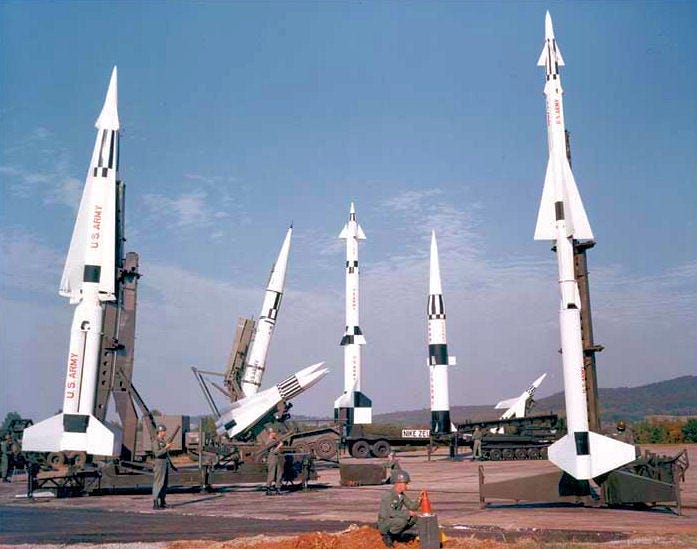
The sites would include trained gunners, and radar and electronic specialists on full-time duty. The squadron would be made up of six officers and 88 enlisted men, majority career soldiers, at each site. Interestingly, many of the local sites are in prime birding locales today: Skokie Lagoons, Argonne National Laboratory, Indiana Dunes, Wolf Lake, the Cal-Sag Channel, Burnham Park, and Jackson Park. Lake Michigan prevented setting up missile batteries on the eastern flank of the city. Placing them on warships in the lake was too expensive, so the next best options were the lakefront parks. One site positioned at the end of a runway at Meigs Field eventually was moved because of the obvious hazard to planes.13
The layout of the batteries leads us to one of the misconceptions about the Magic Hedge. I thought I’d heard that the shrubs covered up missiles at Montrose Point. But that never was the case, despite the area’s use as an artillery site going back to the late 1940s. The important thing to remember is that the Nike missiles themselves were never placed at Montrose. The missiles were stored in magazines 24 feet underground at the southern edge of Belmont Harbor, approximately 1 mile south. Montrose served as the command center and radar site, located where the beach house is now, in smaller buildings that may or may not remain. The barracks for the 100 or so men stationed there were uphill from the command center, at the center of Montrose Point, roughly where the Magic Hedge is today.
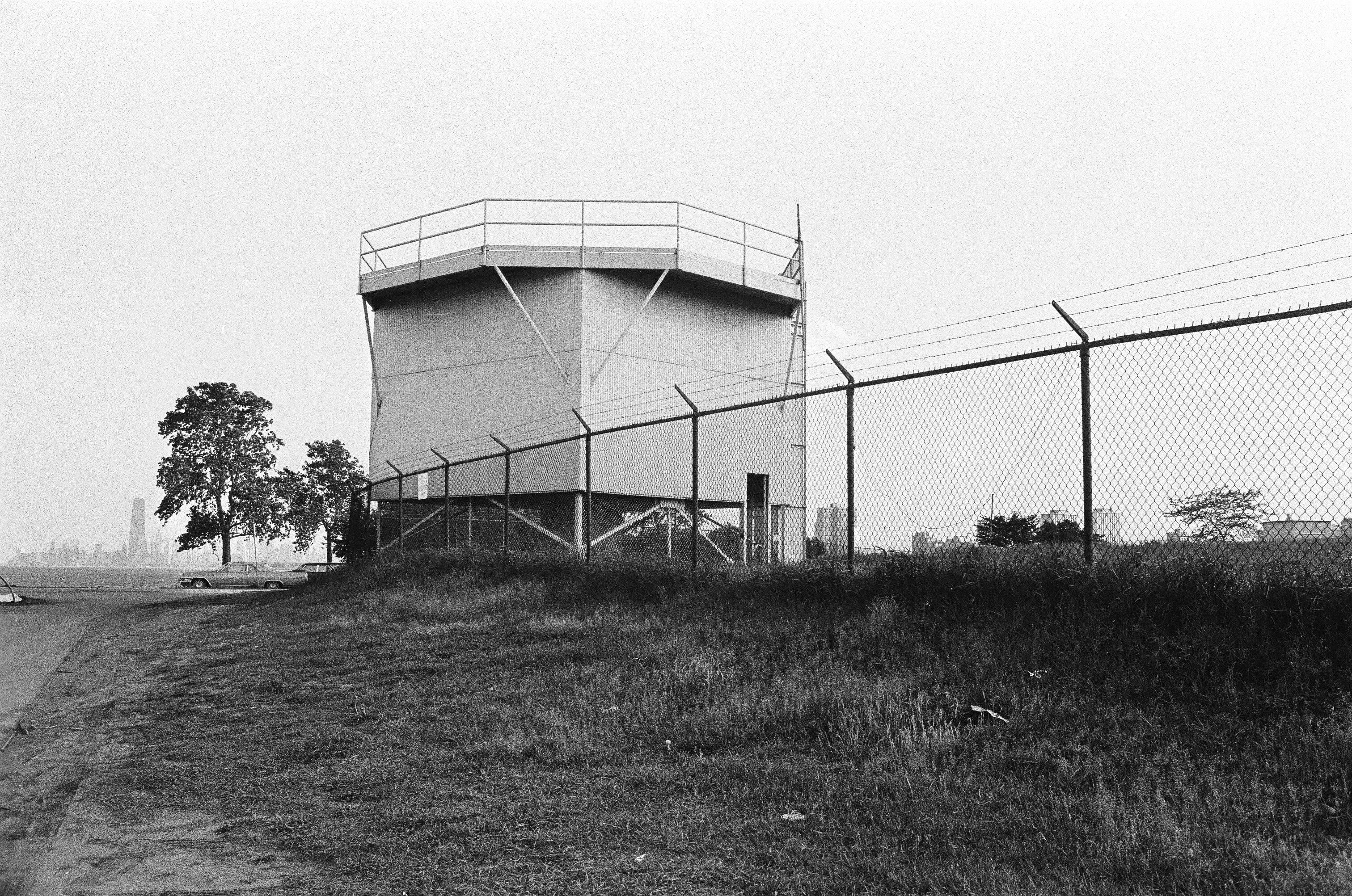
Every site in the Nike missile program was designed in a similar way, with the command center, sometimes called Integrated Fire Control, about 1 mile away from the underground magazines like those at Belmont. The adjacent barracks at Montrose included mess, recreation hall, and a motor pool. At this time, and for many years afterward, vehicles could drive out to the far eastern edge of the point via a road on the southern edge. You can see two cars parked in the photo at the top of this post. It must have been convenient for the anglers going for perch and smelt off the point!
As for the appearance of the barracks themselves, I have yet to find a clear photo of the structure at Montrose Point. In the next post, we’re going to get a glimpse of some rarely seen aerial photos of the point in the ’60s and ’70s. But finding a ground-level shot of the barracks would take a level of digging that is impractical as of this writing.
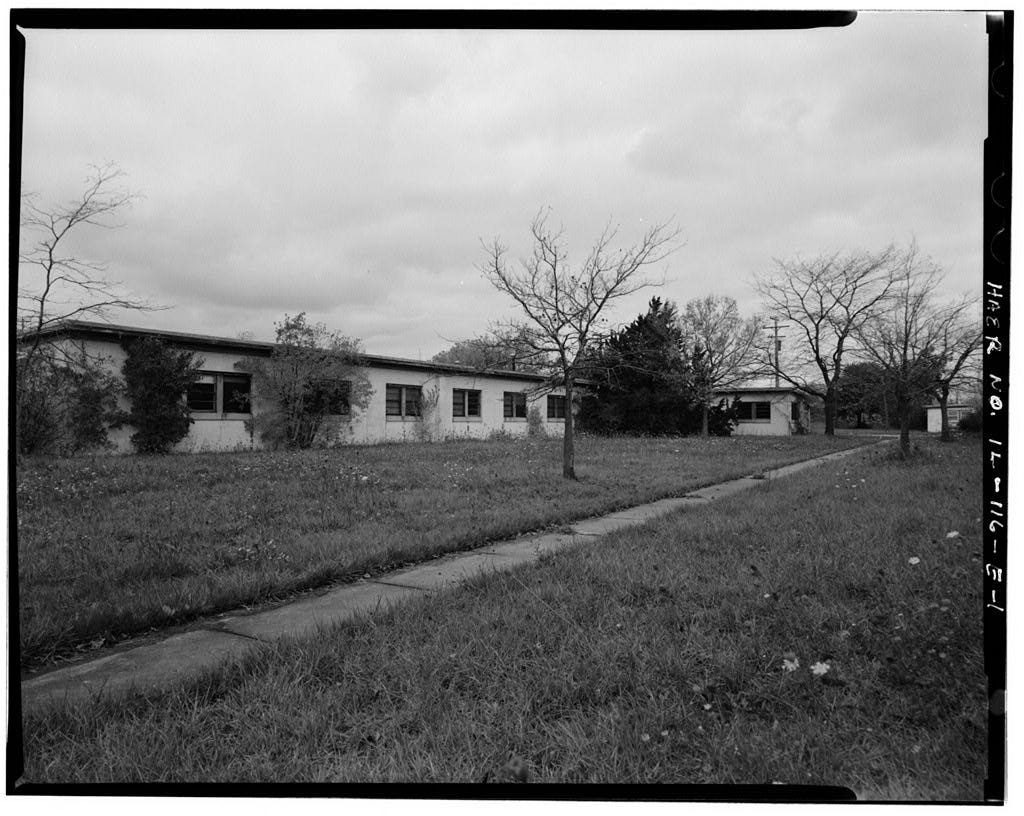
Other installations in the Chicago-Gary defense ring offer some clues, though. They likely were simple one-story rectangular structures that served as residences and administrative buildings. Radar towers were large and spherical in shape; the launcher areas, like the one at Belmont Harbor, look like mini airport runways or tarmac. In Barrington, Illinois, part of the Palatine installation, a 1968 image shows what a barracks looked like a few years after closure. There are a few scattered trees and some overgrown shrubs and not much else. Nothing here suggests a hedge was a standard component of missile site landscaping.
Another site, near Wheeler, Indiana, may still be visible today. In a 1999 application for the national historic register, it was said that “Although deteriorated, the buildings of both parcels are basically intact…Buildings in the Control or Administration Area are in fair to good condition.” The area for that site now appears to be used for a paintball business called “Blastcamp,” appropriately enough.14
One question that’s arisen is whether the warheads in Chicago were nuclear. A newspaper announcement said Chicago was getting atomic weapons, around the time the Hercules generation of the Nike deployed in 1958.15 The army displayed an atom-tipped Hercules at Belmont Harbor, though it wasn’t immediately deployed there. The Portage-Wheeler installation certainly had nukes; the idea was that a short-range nuclear weapon could take out a whole squadron of bombers at once.
The placement of the missiles in Chicago faced public outcry from pacifists and environmentalists. Just a year or so after opening the missile base, a $20,000 initiative sought to beautify the entrances to the Nike sites at Montrose/Belmont Harbor, Burnham Park, and Promontory Point/Jackson Park.16 Most likely these dollars funded the shrubs that became the Magic Hedge. The plantings arrived because residents had spoken out against unsightly radar towers and other structures, all surrounded by barbed wire fencing.
In less than two decades, the plans for Montrose Point had gone from Burnham-inspired natural beauty and recreational space to something far different. Next time we’ll take a look at one of the people who opposed the Chicago bases and what happened when the army finally left. By the late ’60s, the Nike bases were becoming obsolete with the advent of intercontinental ballistic missiles.
Enjoying these posts? Buy me a coffee by clicking the button below to make a one-time contribution. Your support makes This Week in Birding possible.
“Ask Geoffrey: Old Missile Sites in Chicago,” WTTW.com, March 1, 2022.
“Semiannual Report of the Secretary of Defense,” Washington: United States Government Printing Office, 1953.
“Lay Plans Here to Defend Soo If War Comes,” Chicago Daily Tribune, November 14, 1948.
The Gales of November: The Untold Story of the Edmund Fitzgerald, John U. Bacon, New York: Liveright Publishing Company, 2025.
Lonnquest, John C. and Winkler, David F. “To Defend and Deter: The Legacy of the United States Cold War Missile Program,” Washington: Legacy Resource Management Program, Department of Defense, November 1996.
“Civic Leaders See Artillery Defense Tests,” Chicago Daily Tribune, September 22, 1951.
“Defends Nike, Gun Batteries on Lake Shore,” Chicago Daily Tribune, March 20, 1956.
Robitaille, Paul, “History of the Niagara-Buffalo Army Air Defense, 1952-1970,” March 24, 2015.
“Shells Fired By Lightning: Army Ammunition Blasts Terrify Northwest Side Area,” Chicago Daily Tribune, July 6, 1953.
Chicago Daily Tribune, March 20, 1956.
“Army Will Ring Cities with New Guided Missile,” Chicago Daily Tribune, March 28, 1953.
“How Guided Missiles Will Guard Chicago Against Air Raids,” Chicago Daily Tribune, May 8, 1955.
“45th Giving Up Site for Guns in Meigs Field,” Chicago Daily Tribune, November 28, 1953.
National Register of Historic Places Application Form, Nike Missile Site C-47, received December 14, 1999.
“City’s Defense Bolstered by Nike-Hercules: Unveil Atomic Missile in Belmont Harbor,” Chicago Daily Tribune, August 30, 1958.
“Army Reports Beauty Plans at Nike Sites,” Chicago Daily Tribune, January 10, 1957.
This is fascinating! I lived just a few blocks from Belmont Harbor for a decade and walked the stretch of lakefront from Belmont to Montrose more times than I can count and I had no idea about this history.