


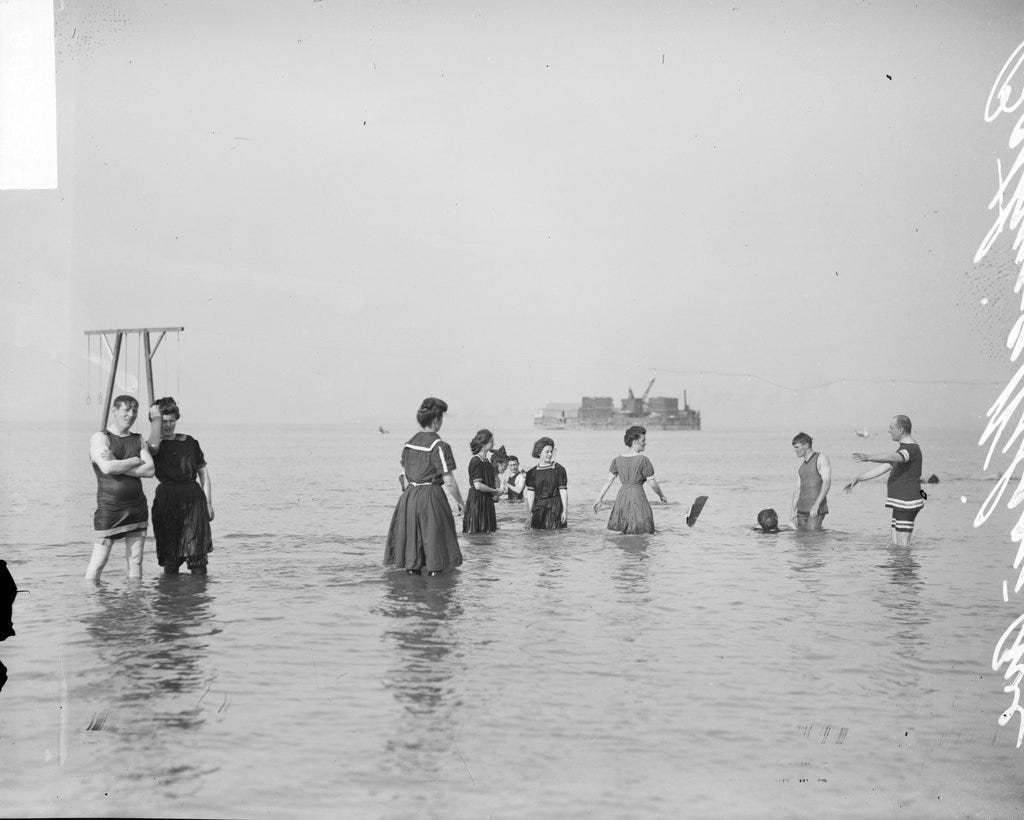
To understand the story of Montrose Point, the No. 1 birding locale in the state, home of nesting Piping Plovers, and the visiting Snowy Owls of late 2025, one has to go back more than 100 years. At the turn of the 20th century, there wasn’t a Montrose Point. Lake Michigan lapped at a beach along Clarendon Avenue, approximately 1 mile inland from where Montrose Beach is now.
The 1909 Plan of Chicago, co-authored by Daniel Burnham and Edward Bennett, included a vision for lakefront parks extending all along the city’s shore. Burnham and Bennett1 viewed these lands as recreational, an escape from the drudgery of daily, manual labor.2 One difference from what came to be: the Burnham plan featured a chain of islands from downtown north all the way to Wilmette.3
The city began extending and expanding parkland northward as part of a plan adopted in 1919.4 First from Diversey to Montrose, beginning in 1925, then the Montrose-to-Foster extension that added 308 acres of land to Lincoln Park, including “the largest artificial bathing beach in the world,” what is now Montrose Beach. The Outer Drive would be expanded to ease congestion from cars that had clogged Sheridan Road and Clarendon Avenue.5 There was also the hope that visitors to the 1933 World’s Fair could motor along the lake for the entire length of the city.6
Planners accommodated the extremes of Chicago’s climate: protecting the Outer Drive and adjacent property from vicious winter storms and providing sandy areas for swimming when temperatures approached 100. Burnham’s plan envisioned a waterfront “playground” and grassy areas that ran up to beaches where the lake could meet the shore untrammeled.7 The interwar plans for recreation included a new yacht harbor—the deepest in Chicago—and an 18-hole golf course as well as picnic grounds and tennis courts.8
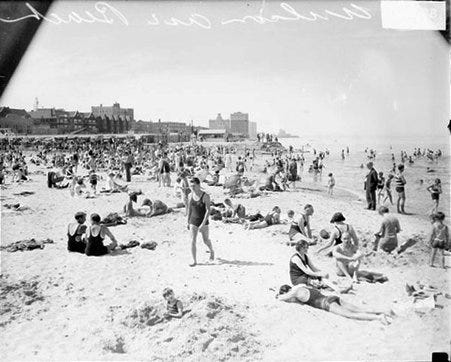
The beaches along the North Side lakefront were being overcrowded with bathers in the 1920s. The entirety of the North Side project would expand capacity to 185,000 bathers.9 More than 30,000 people had flocked to Clarendon Beach on a single day in the early 1920s and nearly 450,000 had visited annually. Included in the 1920s-era plan was a $500,000 pavilion “with every modern convenience” at Montrose Beach. Some portion of this may still stand today.10
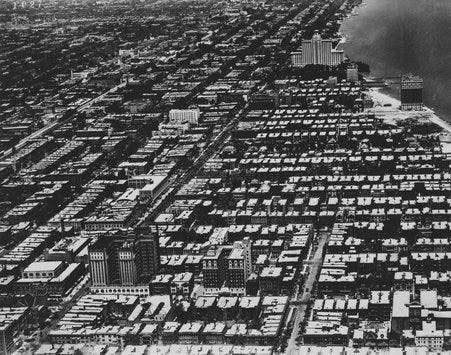
All was well and good until a resident of Wilson Avenue named Clementine Eddy Fisk protested the loss of waterfront by filing a lawsuit. Pushing the lakefront out by almost a mile would be a loss of beachfront property and lake views. In the 1930 Census, she and her husband, William, both 65, listed their occupation as “dry goods.” Mrs. Fisk disputed the plan for two years. A judge eventually ruled in favor of the condemnation of the Fisk property, a 158 by 298 foot lot at Wilson Avenue and the lake.11 At the center of the dispute were riparian rights, but the decision allowed the condemnation of private property for public use. Mrs. Fisk’s primary residence was at 844 Wilson Avenue, a half-block inland from the lake, so presumably she could remain in her home. The park board then proceeded with contracts for the construction of a park fill from Montrose Avenue to Foster Avenue.
January 1931 renderings showed the expanded lakefront and Outer Drive, North Avenue Beach, Montrose Avenue Beach, and a never-built Edgewater Harbor.12 That included a beach on the north side of the harbor that would have been parallel with Devon Avenue. About where Loyola University’s lakeshore campus sits today.
Warren Wright was President of the Lincoln Park Board and President of the Calumet Baking Powder Company. In extolling the benefits of the extended Lincoln Park, in April 1931, Mr. Wright said, “The taxpayers of the Lincoln park district are like the stockholders in a going corporation, except that instead of receiving cash dividends, the returns on their money are computed in the use of the park system and participation in the recreation and pleasure that park activities afford.”13
Some accounts suggest work began on the extension in 1929. The harbor got under way in the Winter of 1930-1931. Beach construction between Montrose and Wilson started sometime the following year, as part of the Chicago Jubilee Celebration. The piers that protruded—Montrose and North Avenue stand out in particular—were meant for recreation and to corral sand for the beaches (the lake’s prevailing currents are from north to south).14 Lake-bottom dredging of sand filled in what nature couldn’t.
By August 1934, an article in the Daily Times described newly opened Montrose Beach, complete with lockers, showers, and comfort facilities as well as brick ovens for beach fires. Columnist Jane Logan, however, wrote that the bulk of North Side beaches lacked “the comfort facilities necessary to protect bathers from disease germs.”15 The Board of Health deemed several beaches unsafe, including Montrose (listed as Wilson), and called for expanded comfort stations and showers. Boaters were at fault, too, and Belmont Harbor was described as “an absolute menace to health.” (These newspaper stories suggesting a 1934 completion of the extension would seem to dispel the notion that the Montrose extension was driven by the New Deal or was a Works Progress Administration project—claims this author has seen elsewhere. The New Deal didn’t begin until 1933 when FDR took office; the WPA did not come into being until May 6, 1935. Funding for the extension was provided by the issuing of bonds in the late ’20s.)16
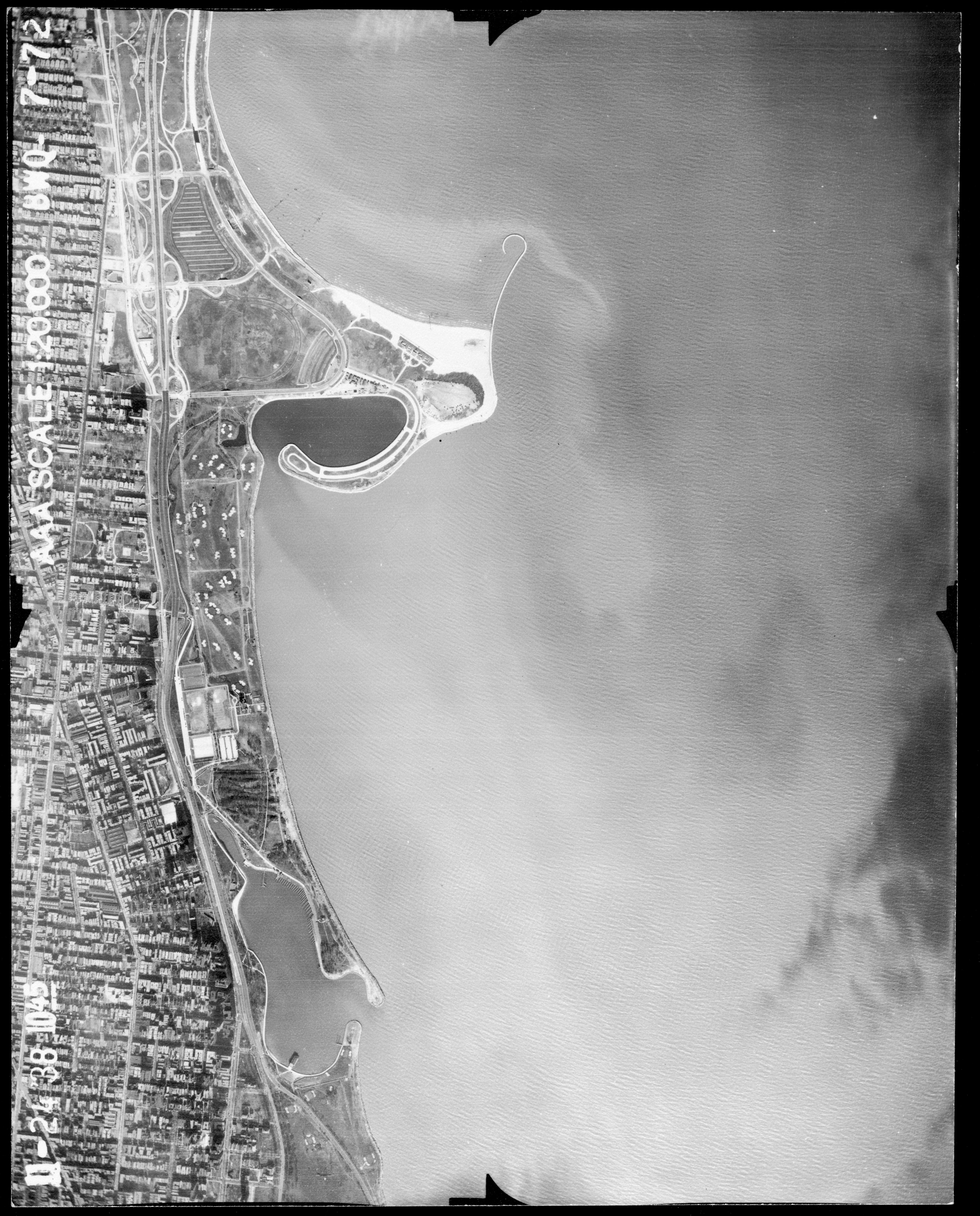
It was around this time that the esteemed landscape architect, Alfred Caldwell, proposed a design for the middle of the point, the roughly circular area that is the Montrose Point Bird Sanctuary today. Caldwell adhered to the principles of the Prairie School and was an acolyte of Jens Jensen, who’s known for designs including Columbus Park, Garfield Park, and Humboldt Park. Caldwell is perhaps most known now for Chicago’s Alfred Caldwell Lily Pool, which is a National Historic Landmark. A 2001 article in Landscape and Urban Planning described Caldwell’s Montrose design as “a large meadow enclosed by multi-layered masses of wildflowers, shrubs, and trees, with openings that created views to the lake and the park landscape beyond the point.”17 The idea was to develop a Prairie School concept known as “the broad view” that symbolizes the open prairie but is enclosed by shrubs and trees to create an experience something like a room with walls. But Caldwell’s design never was built. The attack on Pearl Harbor, and the United States’ entry into World War II, would alter the plans for Montrose Point. More in a future post.

Enjoying these posts? Buy me a coffee by clicking the button below to make a one-time contribution. Your support makes This Week in Birding possible.
Edward H. Bennett served on the Chicago Plan Commission until at least 1924, according to a Chicago Daily Tribune article, from April 16 of that year.
Burnham, Daniel H. and Bennett, Edward H. Plan of Chicago. Chicago: Commercial Club of Chicago. 1909.
Wille, Lois. Forever Open, Clear, and Free: The Struggle for Chicago’s Lakefront. Chicago: University of Chicago Press. 1991.
Bowes, Frederick M., “The Story of the Lake Front,” Chicago Park District, May 1936. Source: Encyclopedia of Chicago, Shoreline Development.
“Uptown Beach to Be Saved for Another Year,” Chicago Daily Tribune, September 30, 1928.
“Pictures Lincoln Park As It Will Appear for World’s Fair,” Chicago Daily Tribune, April 26, 1931.
Burnham and Bennett, 1909.
“Bill for Great Playground on Lake Introduced,” Chicago Daily Tribune, April 6, 1929.
“Bathing Beach for 185,000 Offered By Council,” Chicago Daily Tribune, April 16, 1924.
Some might say, not very modern today! If you have been there on a crowded hot summer day you know what I mean.
“Court Clears Way to Extend No. Side Drive,” Chicago Daily Tribune, September 30, 1930.
“How Lincoln Park Board Plans to Develop North Side Lake Front,” Chicago Daily Tribune, January 25, 1931.
Chicago Daily Tribune, April 26, 1931.
“Hearing Is Set on Two New Jetties for Beaches,” Chicago Daily Tribune, August 11, 1929.
“Jane Finds Bathing Beaches Unsafe,” Chicago Daily Times, August 19, 1934.
“Passage of Bond Issue to Speed Lake Drive Link,” Chicago Daily Tribune, February 26, 1931.
Gobster, Paul. “Visions of nature: Conflict and compatibility in urban park restoration,” Landscape and Urban Planning. 56. 35-51. 2001.
I love thinking about and seeing what my grandparents and parents experienced while living in Chicago. Thank you.