


It’s August in the wilds of the Upper Midwest. It’s humid, there’s just been another rain, and I’m sitting in a slightly sticky campground. A little bit of fog hangs on the hills. The music on the radio is classic rock—and not the good stuff. This is “Rock and Roll, Hoochie Koo” and “Sweet City Woman.”
Even the birds at this time of summer are a little tired. The woods are quieter and the songs are mostly gone. The Great Crested Flycatcher, with its bright sulphur knickerbockers, calls less emphatically than it did a couple months ago. The ever reliable Eastern Wood-Pewee—the pe-weet—is still singing, but others are reduced to call notes, squeaks, and squawks. There’s no cell signal here so Merlin is out of the question.1 I’m trying to decide if an ill-defined whit is a thrush, or vireo, or even a woodpecker.
Upon arriving home, there’s an alert from the Chicago Bird Alliance that fall migration is already under way. The Cornell Lab’s Birdcast is now tracking the large movements of birds expected between now and November.2
The weather will break soon, and a fresh season of birding will be here.
AI lands in archives
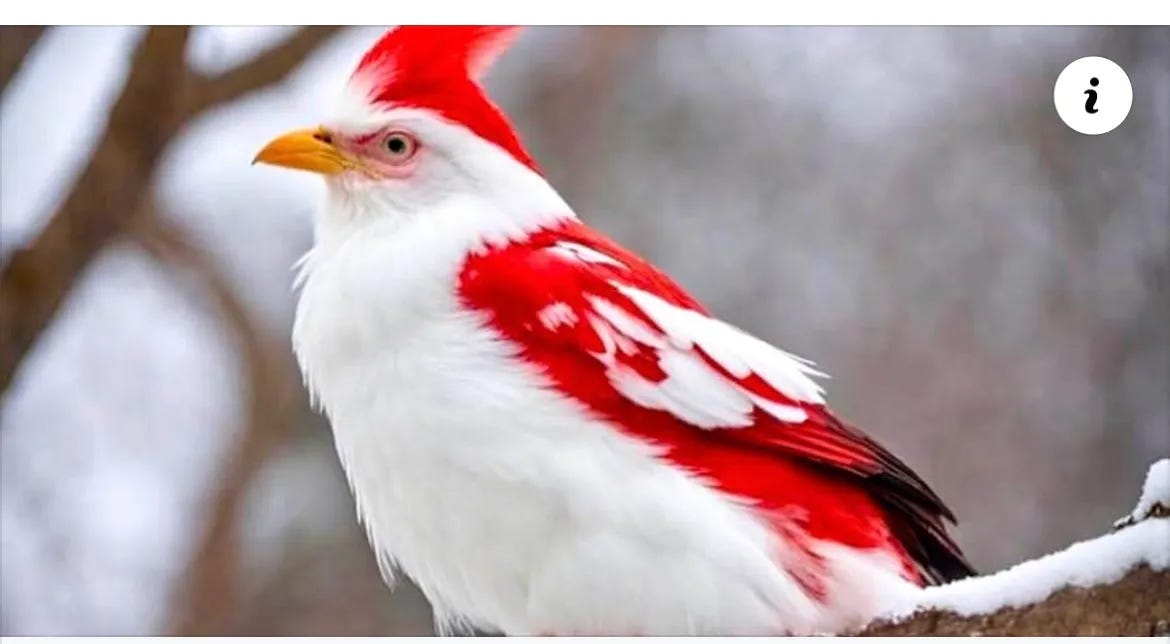
Macaulay Library and eBird recently wrote about the threat of AI to media archives. It seems birding and nature are ripe for AI-generated images and AI-enhanced over-editing.
The Macaulay Library aims to document the natural world through digital media for scientific studies and future research and applications, and as such photos submitted to it through eBird are considered a record of where and when species occur, their behavior, what they look like, and the habitat they occur in. AI-introduced changes alter that natural truth, eroding the credibility of the ML archive among other birders and the scientific community.
You might remember the post in this space from nearly two years ago, “AI is for the birds.” I wrote then:
The *only* thing giving me hope when seeing this schlock is that society has been through this before. Tall tales, trick photos, and hoaxes have all been around for a long, long time, and we’ve mostly made it through unscathed.
The Macaulay story goes on to highlight some guidelines and notes that people can now flag images as “over-edited” and “artificial.”
There’s a lot to worry about with AI. Uploading original photos is one way to stay true to real life.
Some scrappy birds
There’s an effort in Pilsen to deny a permit to a scrap metal facility that’s near some interesting birding areas (and a neighborhood that has long suffered environmental degradation). It’s possible that the plant is emitting manganese, a potentially harmful metal.
This is a quote from a lead organizer of the campaign:
“We want the communities here to be able to engage with what little nature we do have,” [Ajay] Chatha said. “Despite all the shitty things that happen, this is a very vibrant space where lots of good things also happen.”
Nature and greenspace are often lacking in the corridor from Pilsen southwest through Little Village. But birds keep coming back to some of these spots along the South Branch of the Chicago River. (Here is some video of wintering bird species with the metal plant as the backdrop.)
A healthier environment would be good for bird populations and the residents of Pilsen.
The deer and the woodcock
Audubon Magazine posted a short item last week with some surprising video of an encounter between a White-tailed Deer and an American Woodcock. Those living in close proximity to deer may know that they eat most anything—coniferous trees, tulip bulbs, bird seed, and more. According to the piece, deer also may opportunistically eat bird eggs. So the woodcock sees the deer as a threat and fends it off from a likely nest.
Enjoying these posts? Not ready for a Substack subscription? Buy me a coffee. It’s a simple, low-cost, and hassle-free way to support my work.

If you enjoyed today’s post, you also might like…
Bubbly Creek is home to some scrappy birds

Surrounded by an industrial hardscape, hemmed in by asphalt and concrete, the Canalport Riverwalk only has shreds of anything resembling habitat. The site faces scrap-metal giant Sims Metal Management, which has drawn neighborhood concerns for emitting toxic pollution. The walkway…
With only an AM/FM radio as our entertainment, we listen to a questionable news roundup whose lead story amplifies stereotypes about women’s basketball. This is the story.
Just after finishing this newsletter, a likely Tennessee Warbler was calling at TWiB headquarters.
That encounter with then American Woodcock and the deer was amazing! I hope she was able to fend off that pesky deer! It’s is demoralizing to see less wealthy neighborhoods get business like scrap metal businesses all over the country. Thanks for all the links.
Birds really should be the antidote to overuse of AI, no computer can replicate that gorgeous American Woodcock!