


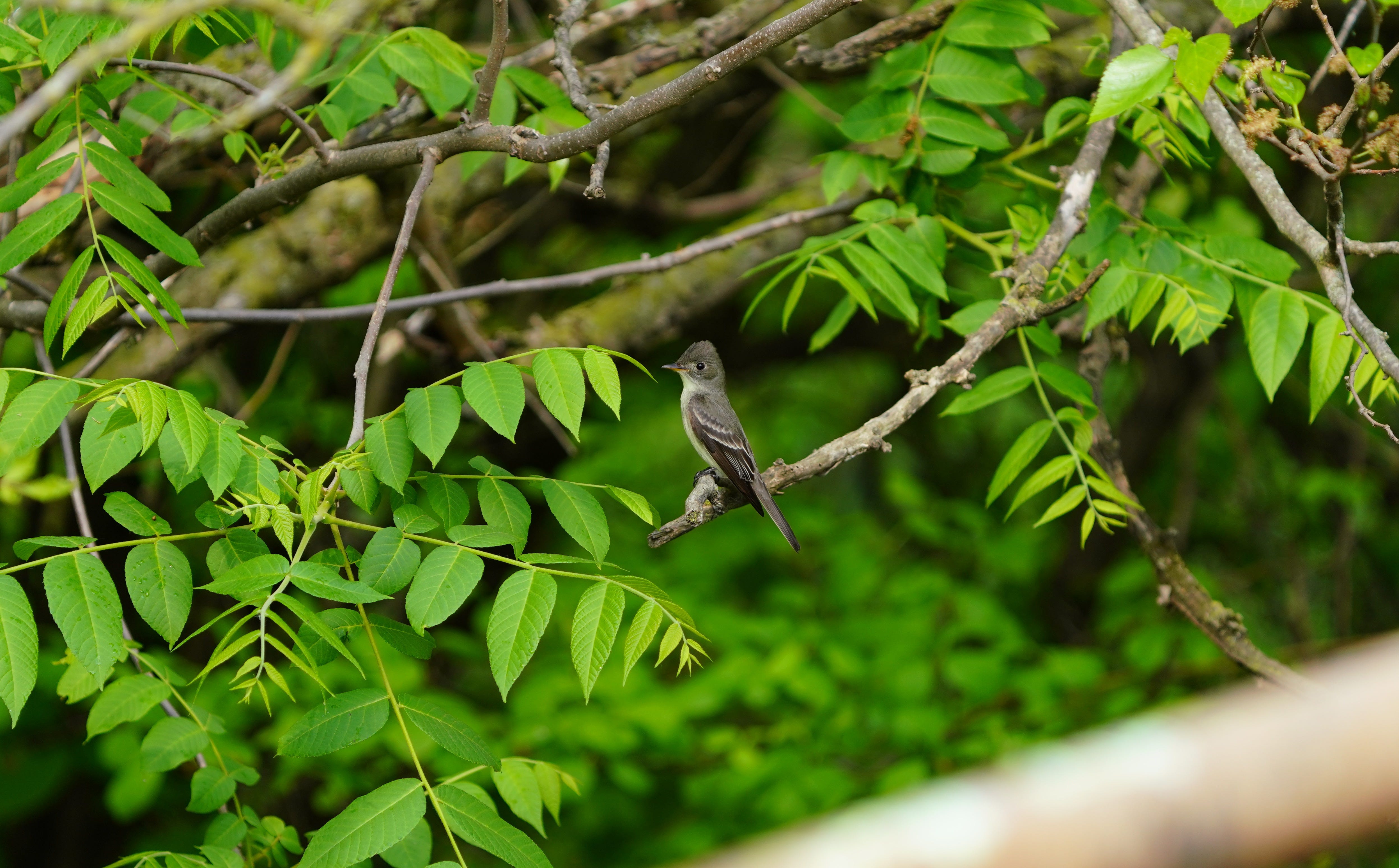
“There is a bird that has built her nest every spring, in the tall tree over the grave. It is a little pe-weet. They are not so fine singers as some others, but I have always loved them, because they belong to our earliest associations. When I used to lead you to school, up the hill-road by the Friends’ Meeting-house, those birds would greet us from the fences and trees, every dewy morning; and I remember so well the delight you used to express, when I could succeed in making you see that it was indeed, no other than a little brown bird that had spoken the name of our elder sister so plainly, that they have ever since been associated with my pleasantest reminiscences of our childhood.”
The above passage is told from Life in Prairie Land, a memoir by novelist and abolitionist Eliza Farnham, who moved from New York’s Hudson River Valley to the champagne country of Illinois in 1835.1 She shares this anecdote from her sister about the “pe-weet,” a bird they knew from the East Coast. Central Illinois is a long way from the Albany, N.Y., area, but this one little bird connects both places. For me, it’s been hearing the same plaintive call of the pewee in recent years at home and in Indiana, Michigan, Ohio, and Wisconsin. There’s something about this bird’s song that taps into so many memories and connections.
Writing in the early 20th century from Wisconsin, Angelia Kumlien Main described the Eastern Wood-Pewee this way:
“The song of the wood pewee, ‘pee-a-wee, pee-wee, peer,’ which is sung in so pensive and dreary a manner, is well suited to the character of this gentle bird. Coming, as it most often does, from the deep, thick woods, the sweet, plaintive notes are in perfect harmony with their forest environment, and are a characteristic sound of late summer, when all but a very few of the birds are silent.
This sylvan bird is, as his name implies, a lover of the cool forest and woodland retreats; and it is here among the tall trees, where the shadows and sunbeams seem to play at hide-and-go-seek with one another, that the wood pewee is at home.”
The great 19th century naturalist and writer John Burroughs wrote about pewees in his seminal Wake-Robin, published in 1871, and noted their superior flycatching abilities:
“The remainder of the summer is the carnival of the swallows and flycatchers. Flies and insects, to any amount, are to be had for the catching; and the opportunity is well improved. See that sombre, ashen-colored pewee on yonder branch. A true sportsman he, who never takes his game at rest, but always on the wing. You vagrant fly, you purblind moth, beware how you come within his range! Observe his attitude, the curious movement of his head, his ‘eye in a fine frenzy rolling, glancing from heaven to earth, from earth to heaven.’”
Main also cites the pewee’s skill as a hunter and goes on to chronicle their many prey items:
“Lucky indeed is the winged foe that escapes these vigilant watchers. On their bill of fare are found flying beetles, ants, butterflies, flies, gnats, mosquitoes, cankerworms, gipsy, and tussock moths, caterpillars, and plant lice. Edward Forbush in his ‘Useful Birds and Their Protection,’ writes that they are often seen fluttering about the foliage of trees, where they pick off caterpillars and plant lice. The most of their food is caught in the woods, although the pewees will sometimes venture into orchards and shade trees growing along country roadsides.”
We’re coming up too quickly on the time of year when the breeding season is over and the woods get quieter. The “latest” pewee I’ve had in recent years is September 25. With any luck, we’ll have a few more woodland experiences before then.
Twas here I found my forest bird,
This sad-voiced singer I oft had heard,
Whose song seemed to float from the top of the wood.
And, as a child, I ne’er understood
How the bird could be so very near
And the song could sound so faint, yet clear ;
Nor how it could float so far away
Mid the shadowy foliage where it seemed to stray
Until it became a part of the shade
That the far off oaks and maples made.
Dear little bird of the top of the trees,
Caressed and fanned by the passing breeze,
You sound so sad and lonely there,
As your pensive song floats through the air.
Were you merry and gay, you would not belong
To the shadowy places that need your song.
Your lay is a solace to the sad, weary heart,
Whose sweet, minor chord doth sympathy start;
So sing, little poet, from yon perch above,
Your song of tenderness , comfort and love.
—Angelia Kumlien Main
Sources in this post: Farnham, Eliza W. Life in Prairie Land, New York: Harper and & brothers, 1846.
Burroughs, John. Wake-Robin, A Collection of Essays about the Birds, New York: Hurd and Houghton, 1871.
Main, Angelia Kumlien. Bird Companions, With Description and Biography of One Hundred and Fifty Song Birds Found East of the Mississippi. Paying Especial Attention to these Birds in Wisconsin, Boston: The Gorham Press, 1925.
Added this gorgeous bird to my life list yesterday at our local State Park! I was so excited. I heard its' call first & right as I was getting ready to leave it flew right in front of me!
I appreciate this bird when I hear its call every year.