


Schuyler Mathews didn’t have to go into the woods and attempt to translate bird songs into musical notation, but he did. For years. Mathews spent summers in the wilds of northern New Hampshire, in the shadow of Cannon Mountain, just to try to turn nature’s music into something humans could understand. Or was it the other way around? Perhaps birds were luring Mathews into their thrall and he was trying to make sense of something inscrutable and impossible to convey through humans’ rudimentary languages. Bird song doesn’t really translate well to the musical staff, such as it is with so many half tones, glides, and an uneven timing. But Matthews tried and tried.
Put yourself in the shoes of a late 19th or early 20th century ornithologist. You don’t have Merlin, or eBird, or any recording device. Not even a Walkman or a micro-cassette player. No reel-to-reel recorders either, those wouldn’t be invented for decades, and even then they would have been unwieldy in the field. All you have are your eyes, ears, experience, and the knowledge imparted by a few others. Even then, you might only have a partial view of nature study, without easily accessible, universally available resources, and only the insights of a few experts in your region.
In order to document bird songs, Mathews hiked through the thickets of the heavily forested White Mountains with a tuning fork and a notebook. Some contemporaries toted a stopwatch, too. He would have had to listen for birds calling repeatedly and long enough to decipher them. He might have tapped the tuning fork with a mallet to determine the key of the bird’s song. Then it was penciling each note onto the staff. Ironically, he called his notations “recordings”—not recordings in the analog or digital form, but a handwritten record of each song.
“Every bird sings his own song; no two sing exactly alike. A sharp and retentive ear for musical form can not fail to recognize those subtile (sic) differences of tone and expression which make the song of every singer unique. There are, of course, similarities in the songs of birds of the same species, but the differences, nevertheless, are as distinct as those by means of which the ornithologist has separated Bicknell’s Thrush from the Gray-cheeked Thrush.”
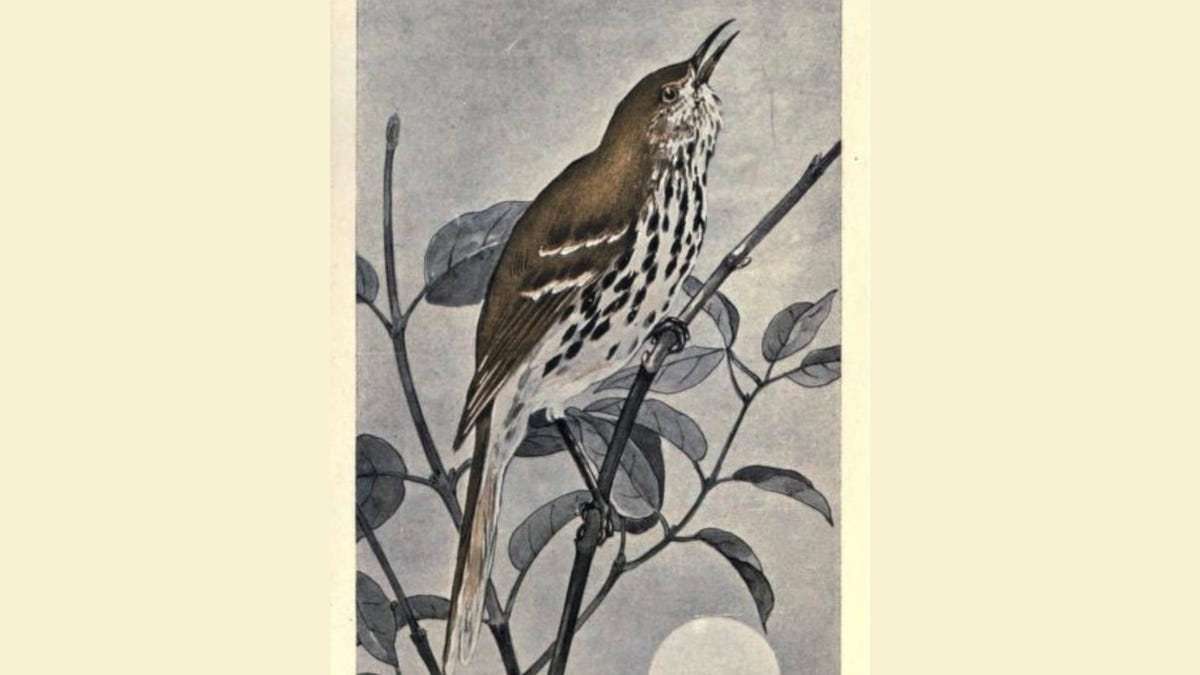
Over the years, he made some exciting discoveries, noting the differences between White-throated Sparrows singing in New Hampshire versus the ones on Prince Edward Island. However, even as he spent decades some of his project was met with resistance or even confusion. Just try to play a bird song on the piano—it’s very difficult to match its pitch and tempo.

Take nature’s clown, the Yellow-breasted Chat. Here’s what Mathews wrote:
“An eccentric character in the largest sense of the word. The song scarcely deserves the name. Putting on musical staff would be a hopeless task. Voice tones without either key or pitch. No kind of parallel in our bird acquaintance. A mere chatterer whose flippant conversation carries on with grotesque syllables.”
Or think about what happened when Mathews tried to translate the Bobolink’s burbling notes. Mathews gave up when it came to the Bobolink and merely suggested the character of the song. It wasn’t just Mathews who struggled to impress with his notations.1
Nowadays, most any of us could record high-quality audio with our phone or a digital recorder with myriad types of microphones. Within minutes, we could review these files and transfer them to eBird or Xeno Canto for others to explore. We are adding to the body of knowledge within a day or so; for Mathews it might have been many seasons, and even then only available to the people who encountered a copy of his book.
Science around this time seems to have often consisted of tallying massive amounts of data. It might be the number of nest burrows in a Bank Swallow colony or the contents of a Prairie-Chicken’s stomach. While we do some of this now (think Christmas Bird Count), we also have ornithologists and organizations synthesizing this into something with meaningful insights. Back in those days, it seemed the data itself was the end goal.2 And while that matters, it leaves a gaping void when it comes to why it’s worth going into the woods to record all of this stuff in the first place.
What strikes me about Matthews, and as I said last week about Florence Merriam Bailey, is how much these folks were in the moment. No cell phone, no distractions, no camera or recording device. Just one’s senses and an exceptional attunement to nature. This wasn’t Mathews’ full-time job either—he was primarily a designer for the Prang lithographic art publishers of Boston.3
Mathews lamented the perception that only occasionally a bird was a “supreme soloist.” It seems that the Gilded Age view was that humans made better music—with their voices and with instruments like the piano. While comparing the two seems absurd, Mathews was undaunted. His enthusiasm for birds comes across clearly, and that’s perhaps what we should take from his works (as well as his artistry).4
“Never does Nature repeat herself; it is not one vast mediocre chorus, it is an endless variety of soloists whose voices, filled with tone-color, redundant in melody, replete with expression, and strong in individuality, make up the orchestra which performs every year the glad spring symphony. The Hermit [Thrush] is the great tone artist, the Red-eyed Vireo is the obligato accompanist, the Song Sparrow is the melodist, and the Partridge controls the drums. But every individual sings his own song!”
Pippin did what now?
If you liked this post, you also might like…


Just a reminder, I’ll be teaching a class at Chicago Botanic Garden this June, on Mondays starting June 8. Curious about the intersection of birds, art, and history? Birds in art do not begin and end with John James Audubon. Delve in and learn about the stories of various birds through historic materials, including the works of Francis Willughby, Mark Catesby, Thomas Bewick, Sarah Stone, and lesser-known figures in bird conservation such as Wisconsin’s Kumlien family. We’ll also get a chance to visit the Lenhardt Library at the garden and explore rare texts in-person.
The eminent ornithologist Frank Chapman tried to make sense of Simon Pease Cheney’s translations in the 1890s. Chapman recognized only one species, the White-throated Sparrow. Source: Bird Song, Aretas Saunders, Albany: State University of New York, 1929.
Admittedly, the subheading to Mathews’ Field Book of Wild Birds and Their Music states that its purpose was to assist others with identification.
New York Times, August 21, 1938.
Mathews also wrote field guides to trees and wildflowers and other beautiful illustrations.
I wish I still lived in Chicagoland and could take your class!
“Every individual sings its own song” could be a lovely metaphor for life anywhere. Thanks for the work you do.