


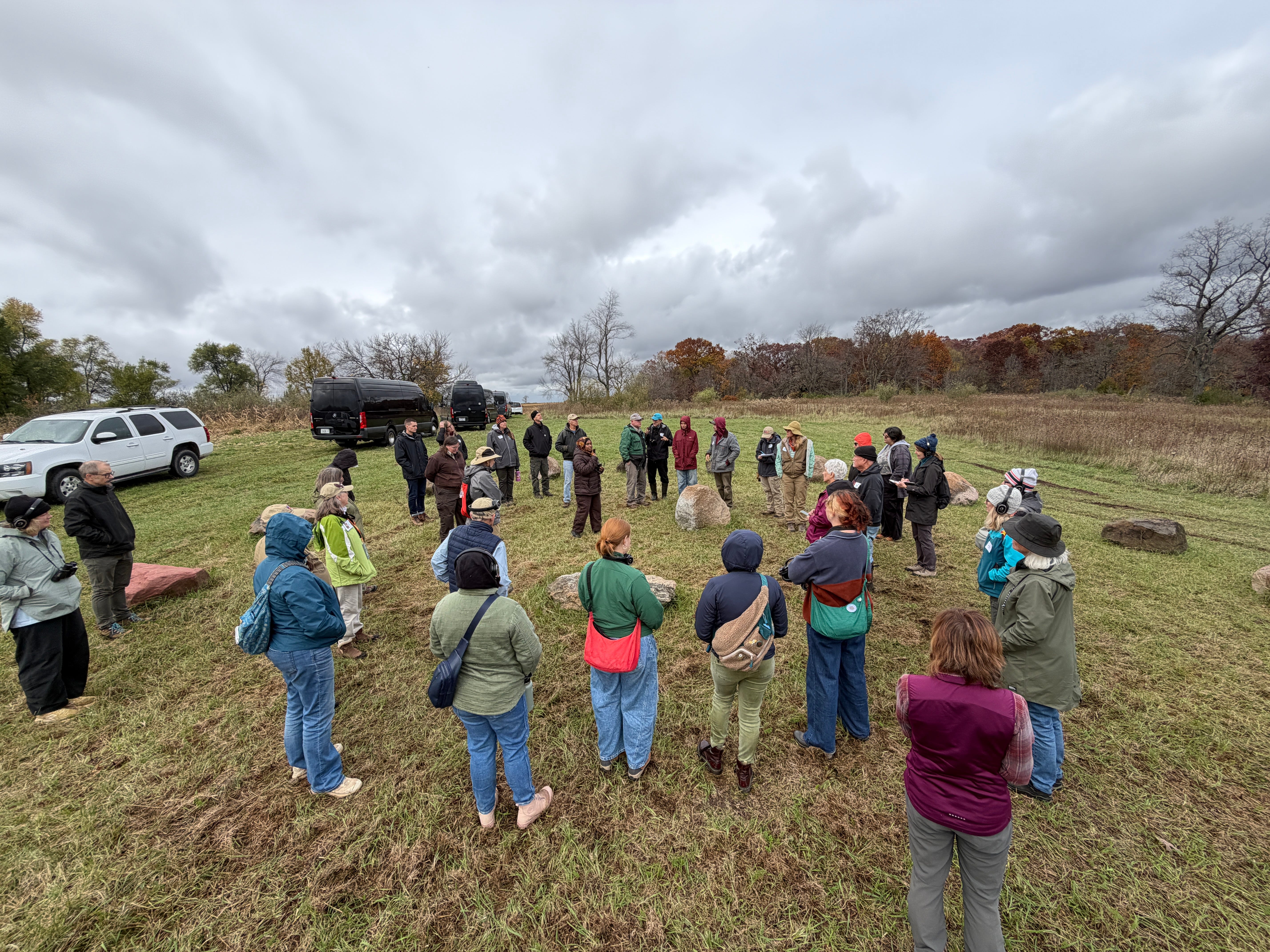
“We want it to look like it did in 1850.” Forty-two people are standing above a restored wetland on a crisp November day. It’s a field trip for conservationists—advocates, technicians, and ecologists—participating in the Chicago Wilderness Congress. Led by volunteers, these are folks who’ve dedicated decades to protecting and restoring our fragmented urban landscape. They’re here because this site on the Illinois-Wisconsin border is an exemplar.
The hydrology at beautiful Hackmatack National Wildlife Refuge1 is reverting to what it was 150-plus years ago, with freshwater springs weeping out of a hillside, and the crayfish and small non-game fish appearing as well.
The last tamaracks in the area were here when this was a wetland in the 1980s, 200 acres drained with tile. Would it be possible to restore these deciduous-conifer gems, I think to myself. Then the answer arrives: “There are tamaracks with the same genotype [elsewhere] in McHenry and Lake counties. So we could have them again.”
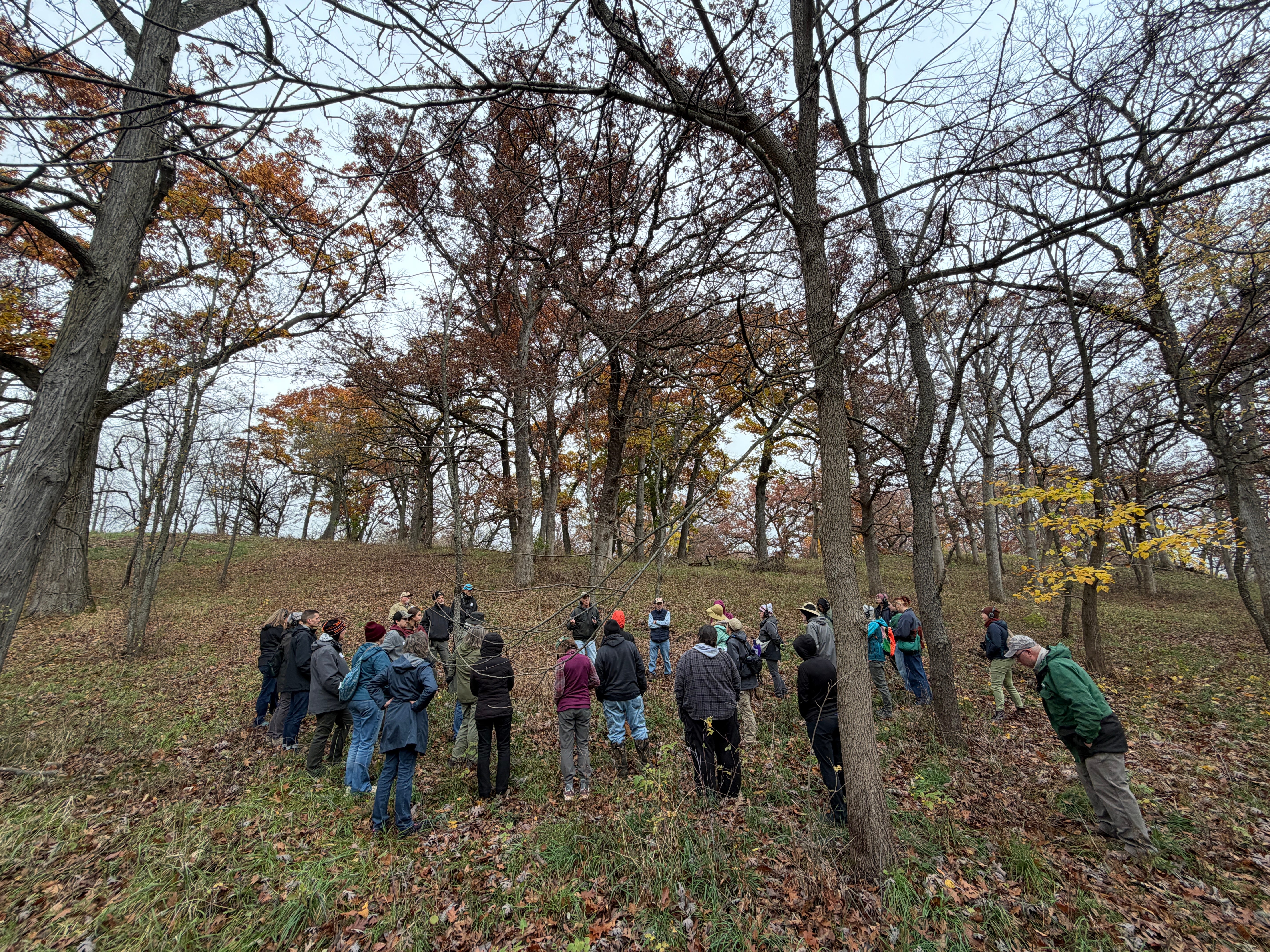
Now we’re standing at a gorgeous savanna on a newly purchased parcel. This site is the largest conservation acquisition in the region this century. The scarlet leaves of the red oak live up to the name. “What do we do with our small half-acre savanna of 25 acres in Will County?” The question suggests the oaks might not be there forever unless new ones start to spring up. That means getting more light down to the ground and fewer invasives like buckthorn and honeysuckle. I get the feeling oak savannas are finicky.
“It’s tough decisions as to what to remove to open up the canopy. We have box elder, cherry, and walnuts…” Sometimes taking care of an ecosystem as fickle as an oak savanna requires removing some less desirable species. A multiflora rose, originally from Asia, is underfoot during the discussion.
What about all the deer, do they eat the young oaklings? “Deer are a problem everywhere,” it’s said. Visions of the fenced-off oaks in my nearest forest preserve appear. One jurisdiction will plant 1,200 oaks this October; 50 percent will be caged. But there’s more: we need squirrels to help out and cache more acorns. When squirrels cache them,2 the mice and voles won’t get to them before they can sprout. Or is that the mice and voles eat the bark from the young oaks? Either way, the question speaks to the peculiarities of re-assembling an altered ecosystem. In the past, wildfire kept the savanna under control—the oaks were smaller and the hazelnuts bushier. Now, we’re just glad a few stands exist, somehow avoiding the inexorable march of development.
Seeing double? A Mark Catesby mystery
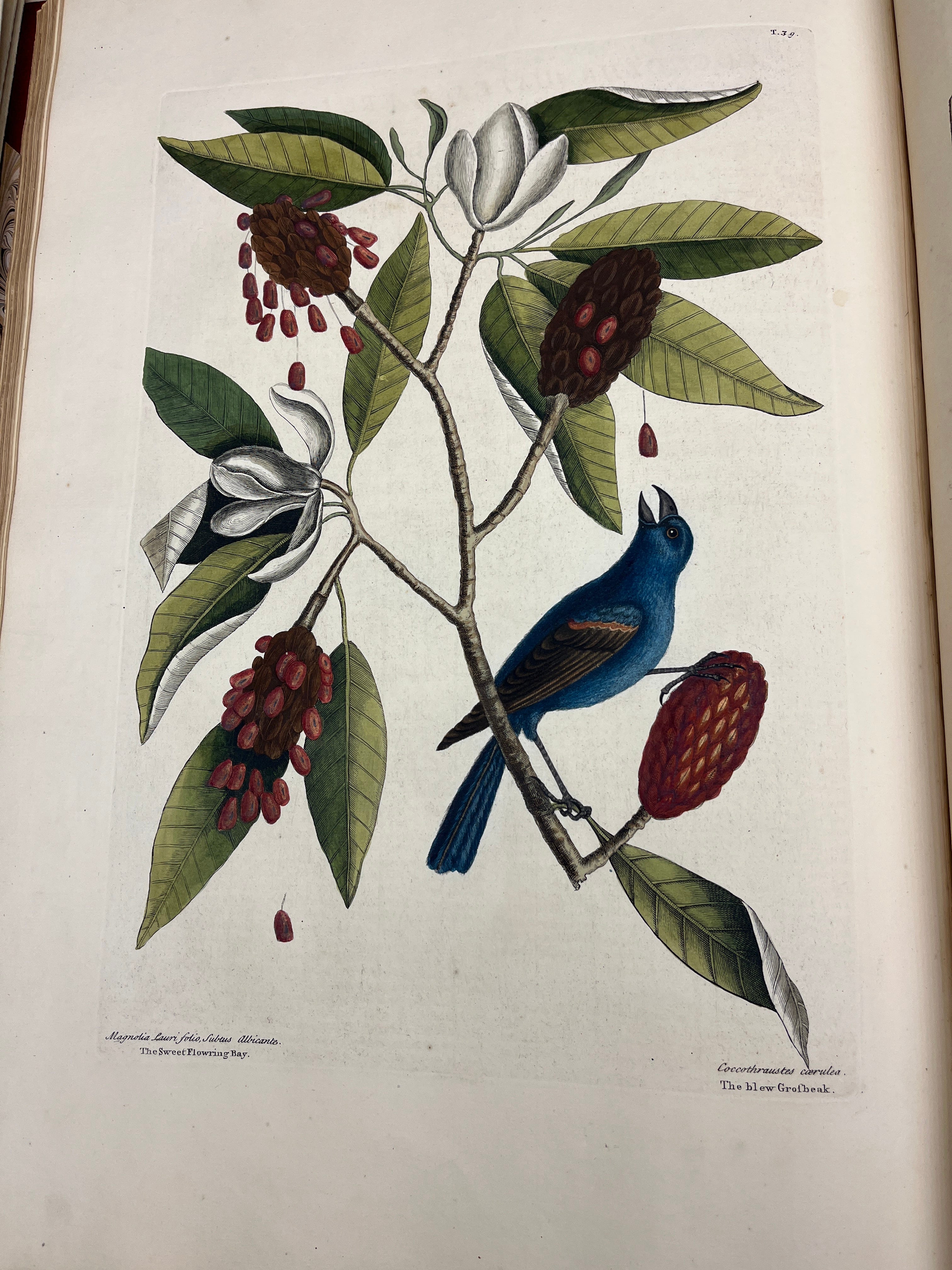
A brief tale from my day job. Over the past couple years, I kept encountering two copies of Mark Catesby’s 1743 Natural History of Carolina, Florida, and the Bahama Islands in the Newberry’s collection. It took me a remarkably long time to realize I had been requesting two versions of the work—and that the two weren’t identical.3 Then I spoke with a colleague and learned that one of the copies may have been owned by George Edwards, the “father of British ornithology.” Edwards was a contemporary of Catesby’s and it’s presumed he hand-colored the engravings in Natural History. He received the Copley Medal from the Royal Society in 1750 for his sustained achievements in science.
But why did the Newberry have two copies? And how did we get them?
That required turning to the library’s first accession books from the late 1880s and early 1890s, a handwritten chronicle of early acquisitions. I found out a few things, but there are are still some questions about how these books came across the Atlantic to Chicago—one spent a fair bit of time in Cincinnati as well, thanks to the collector Henry Probasco.
Tarik Shahzad does it again
When last we checked in with Tarik Shahzad, he had just broken the Cook County big year record with 294 species in 2024. Then he beat that record again in 2025. Now he’s reached the 300-species mark after notching an Ash-throated Flycatcher a couple weeks ago in Chicago’s Douglass Park.
To put things in perspective, that’s 300 species in one year in this county…our No. 1 hotspot, Montrose Point, has had 354 species ever.
“I’m (filled with) an outpouring of gratitude to the Illinois and Cook County birding community,” Tarik said to the Chicago Tribune. “We stand on the shoulders of giants, and without them and their decades of conservation work, I wouldn’t have seen a fraction of these birds.”
The Tribune had a nice feature on Tarik and also highlights Park 566, the former site of U.S. Steel’s South Works. Tarik often stations there rather than Montrose as there’s a greater chance for certain species than points north.
[Tarik] bent over and pointed to black, volcanic-looking rock. He said it was slag, a waste byproduct from steel manufacturing.
“A lot of this is actually pollution,” Shahzad said. “And it’s stuff that hadn’t been remediated. So there really isn’t justice, and a lot of the environmental hazards remain here.”
While that sounds like a health issue waiting to happen, inveterate birders will tell you that regular trips there won’t hurt you. Park 566 is well worth the trip.
Watch Broken Flight on YouTube
Broken Flight is a film about building collisions and the people helping to save birds. Directed by Erika Valenciana and my frequent collaborator Mitchell Wenkus, it was an official selection of the Chicago International Film Festival and is now available on YouTube (link above). Broken Flight was beautifully filmed over several years, with close-ups of a wide variety of our most brilliant local species. The messages are that birds are a vital component of our ecosystem, that Chicago is a crossroads of migratory routes, and that there’s still an opportunity to educate people. It’s timely that this arrives just as City Council is considering an ordinance to ensure bird-safe construction in the future.
I imagine Blue Jays could be helpful, too.
It can be hard to distinguish similar items in our online catalog. Sometimes it requires keeping careful track of call numbers and little details in the works themselves.
Finicky and fickle. I’ll keep those words in mind as the inevitable disappointments happen while restoring some of our farm to an oak savannah. It’s always good to have help managing expectations. LOL!
Peeking in from the NW, you do excellent work! I want clean energy but I’m concerned obliterating windmills.