


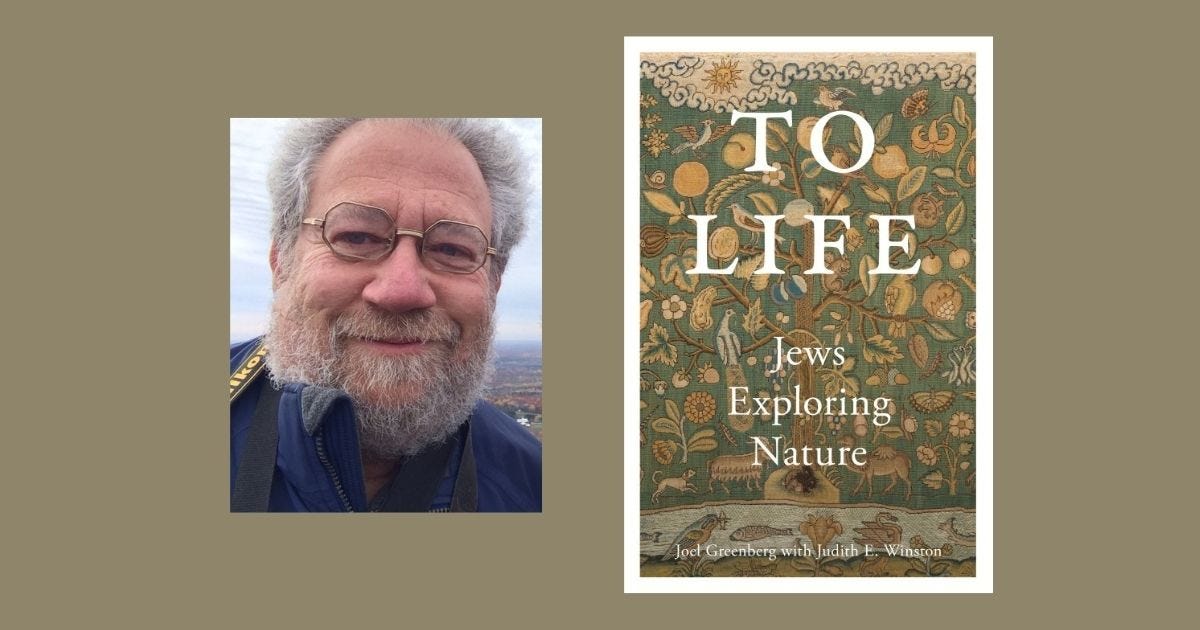
Joel Greenberg is a lifelong naturalist and noted author who’s written or co-written four books. His Natural History of the Chicago Region (2002) is a must-read for anyone into Midwest ecosystems, and A Feathered River Across the Sky: The Passenger Pigeon’s Flight to Extinction (2014) is the seminal work on the once-abundant birds.
His new book, To Life: Jews Exploring Nature, illuminates significant Jewish thinkers who increased in important ways our understanding of various aspects of natural history. In eight compelling chapter-long biographies, Greenberg demonstrates the diversity of both Jewish identity and the natural sciences.
BD: How did the To Life project come together?
JG: I compiled a list of subjects, about 70. One of my criteria was whether the person identified as being Jewish. Of these 70 people, I would end up with eight. There was a range of people, from Joan Ehrenfeld, who was very observant, to arachnologist Herbert Levy, who was raised Jewish in Germany with a big Bar Mitzvah [but then ceased any Jewish practices once he entered the United States, feeling more German than Jewish]. Then you have mammalogist Philip Hershkovitz, who was so secular his children were shocked to learn they were half-Jewish.
I interviewed 150 people. That’s one reason this thing took 10 years. I had Zoom sessions with folks living in Ethiopia, Israel, China, Beijing, Panama, and other places. The goal was to learn as much about [my subjects] as possible.
BD: So much has been written about Nathan Leopold and Richard Loeb—did you find anything new? [Read more about Leopold’s back story as a birder here.]
JG: Leopold was a mystery even for people who [were close associates]. I was able to interview two people who knew him, including Elizabeth Spiegel, who had gone on bird walks with him through Jackson Park for $1.50. [Leopold] was my one bad apple. But a couple people have said that his chapter was one of their favorites.
BD: Was it strange that someone later convicted of murder led bird walks with kids for $1.50?
JG: Maybe in hindsight, but Spiegel told me she was totally shocked when she heard the news. As part of [the] bird walks, Leopold would organize an annual picnic with the kids and their moms, and everyone enjoyed his company.
BD: Philip Hershkovitz of the Field Museum, a Curator/Mammalogist, is another person with a local tie. Tell us about him.
JG: Four of the people in the book have strong Chicago roots. Hershkovitz, grew up in Pittsburgh with what would prove to be two lifelong interests, music and most particularly neotropical mammals. He transferred to the University of Michigan in 1931 where he received his BS degree and then entered their graduate program. Two years later he decided to leave Ann Arbor and move to Ecuador, which he had concluded would be the cheapest country where he could live in South America and pursue his principal passion to study mammals. His advisor strongly discouraged him from doing this as he had no contacts [and] didn’t know Spanish at all. He was there for maybe four years, and as time went on, he adopted the ways of the locals, went shirtless and barefoot, and used a blow gun to collect specimens. He seemed to have modeled himself after von Humboldt and Darwin and go to remote areas for years at a time.
He was offered a position at the Field Museum in 1948. Just a month later he brought his wife and daughter to Colombia, where his family would reside in cities as he worked the hinterlands in search of specimens. His wife was lonely but never lost devotion to her husband. Her dream was to move to Chicago, shop at the A&P, wear a dress, and have a doctor. [Hershkovitz] came back to Chicago four years later.
But [Hershkovitz] didn’t get along with numerous museum employees, so to avoid any conflicts, the museum created just for him the position of Research Curator, which enabled him to do his mammal work, while not having to deal with tasks or people he wished to avoid. In Hershkovitz’s hundreds of publications only three had a co-author.
BD: I would like to ask you about the region generally since your “Natural History” is such an important book. In a recent post, TWiB featured Eliza Farnham, who was enthralled by this landscape. We also have some of that in The Best-Known Grouse. Why do you think early European visitors were using phrases like “rise of emotions” in this “sea of grass.” Was it just 19th century romanticism?
JG: People were really taken by the prairie. All the way into 1840s, they came to the Midwest having come from Europe, where nothing is remotely like the tallgrass prairie. Going east to west, you go through woods, and it’s not until central Indiana that you suddenly see something that is totally foreign to your existence. That’s why so many made analogies to the oceans and the waves, as it was the thing they were familiar with. It was quite rich, there were bison. Some use the term antelope, though they could have been deer. The first settlers preferred the savannas, the transitional areas where there were trees to build things, while the ground was rich.
BD: You’ve spoken eloquently about the Forest Preserves of Cook County. Do you think they get overlooked somewhat?
JG: Dwight Perkins had a notion of a forest preserve—not a park district—to preserve nature and allow people to enjoy it. People like Perkins understood that humans do best when they have places to run around. Cook County now is the second-most populated in the country, only after Los Angeles, and the Forest Preserve District is 70,000 acres of land. Of the nine counties in the area, eight of them have forest preserves or a conservation district and only one does not [Grundy County]. If you add them up, they have 200,000 acres of protected land. Three of the four counties in the state with the highest-quality natural areas, species diversity, and endangered species, are Cook, Lake, and McHenry. The forest preserves are a huge thing.
To Life: Jews Exploring Nature is available via Rutgers University Press.
New class! The Wonderful World of Bird Behavior
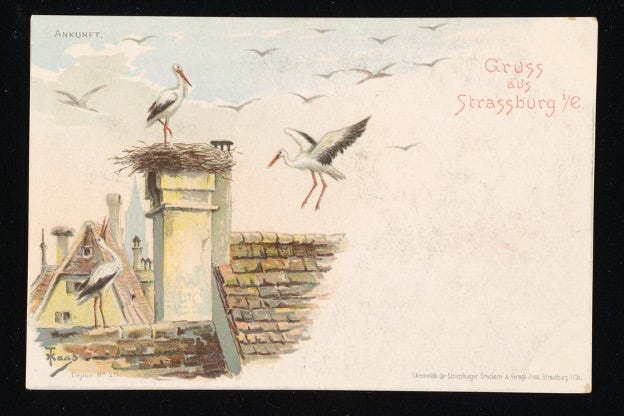
Sign up for my new class at the Chicago Botanic Garden! Starting October 19, in “The Wonderful World of Bird Behavior” where we’ll be reading and discussing bird observations from favorites like Florence Merriam Bailey, Schuyler Mathews, Aretas Saunders, and Alexander Skutch. The class runs four weeks on Monday evenings, 5-6:30pm. On the fifth week, we’ll have an optional morning bird walk at the Garden.
Explore a variety of birds as they sleep, eat, sing, and dance, with an emphasis on midwestern species. Using historical texts, examine the unique behaviors of various species and come away with a better understanding of these often overlooked, but fundamental, aspects of the avian life cycle.
Enjoying these posts? Not ready for a Substack subscription? Buy me a coffee. It’s a simple, low-cost, and one-time way to support my work.

Take action
In case you missed it, last week’s post featured the Flyway City exhibition and ways to take action to reduce building collisions. This Week in Birding is a supporter of the Chicago Collisions Coalition. We want Chicago residents to ask City Council to create a mandatory bird-friendly building design ordinance to reduce the number of building collisions. There are two important steps you can take right now—before the budget season in October.
Send a Letter. If you live or work in the city, click here to go to a form.
Speak with Your Alderperson. Call or visit with your Alder, information here.
This ordinance has long been discussed, protects birds, and makes a lot of sense in the architecture capital of the world.