


The mass collision event at McCormick Place in October 2023, drew national news for all the wrong reasons. The exposition center had long been a problem for birds flying along the south lakefront. It wasn’t until that cold front swept through that the public—and in turn elected officials—began to talk about the problem and taking action (bird-safe film was applied to windows).
Flyway City: Architecture for a Flourishing Ecosystem, the new exhibition by the architecture firm Studio Gang, takes a solutions-based approach and presents ways people can take action to create a healthier urban environment. (WTTW has a wonderful story on the exhibition and collaboration here.) The story of McCormick Place is featured—the number of bird deaths plummeted after bird-friendly measures—along with several other successes.
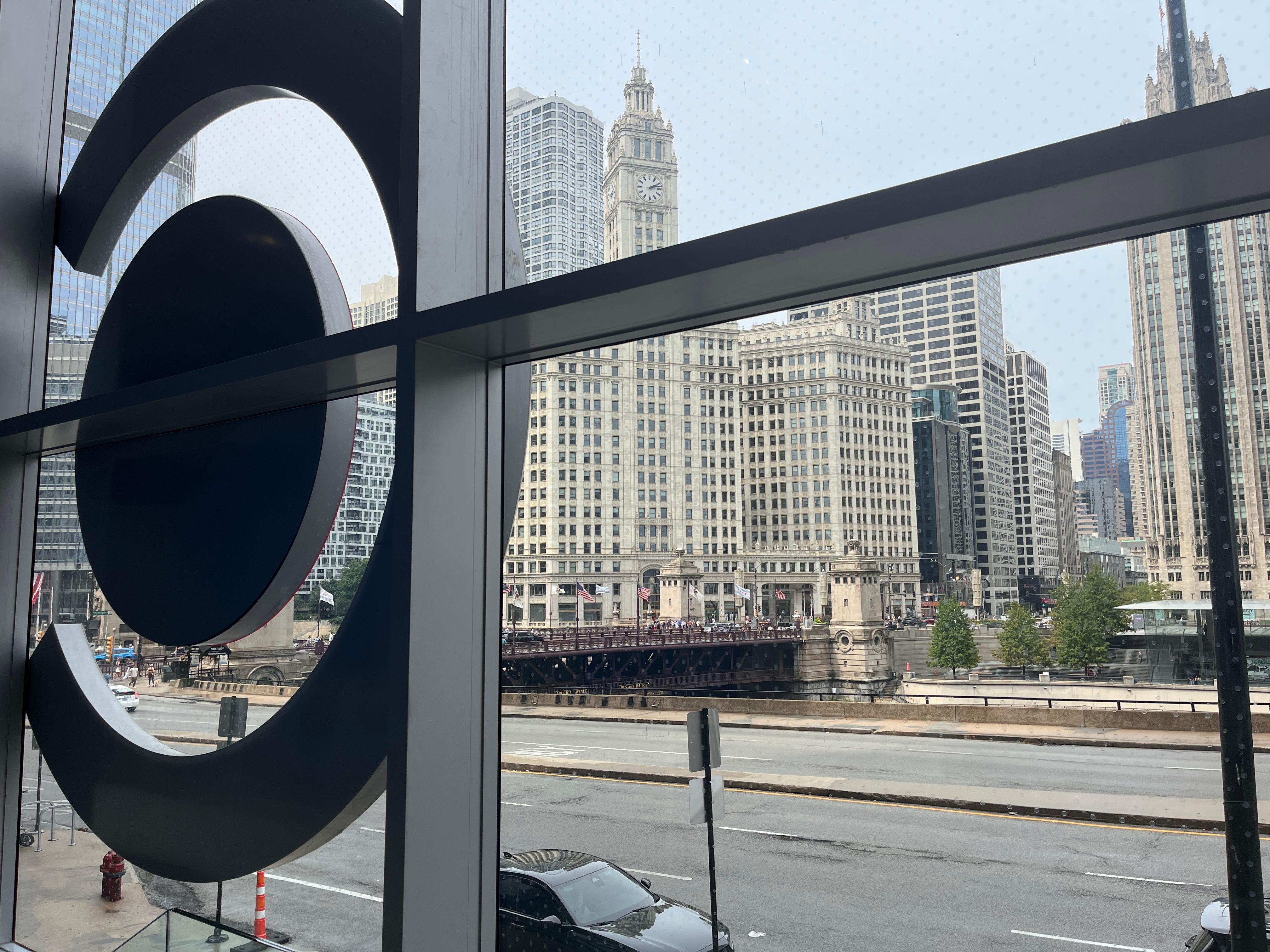
The Flyway City display melds effortlessly into the exhibition space on the second floor of the Chicago Architecture Center, facing East Wacker Drive. The center itself models bird-friendly design. The building’s window façades feature a pattern of UV dots that are detected by birds but mostly invisible to people. The blue curtain dividers are actually scaffolding netting that is a low-cost material used to screen exterior windows to protect birds from collisions. An acoustic monitor was placed on the architecture center building to detect the number of migratory birds, and a small computer display allows visitors to play the game Bird Song Hero.
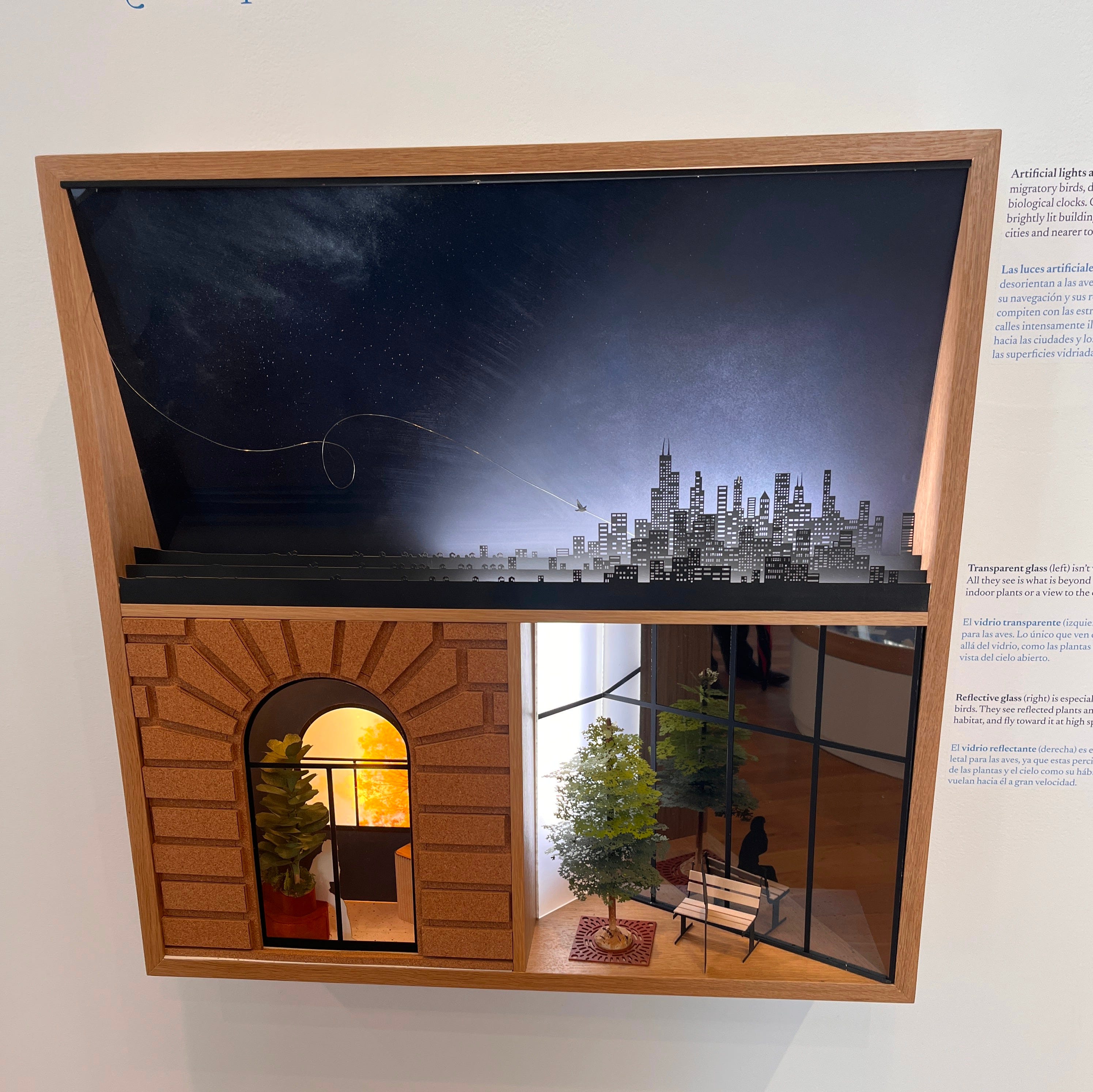
Another display shows how Studio Gang designed a custom bird-safe glass pattern for a dormitory at Kresge College, University of California Santa Cruz. The glass is patterned with playful elements in the forms of frogs, rabbits, owls, and bats. Rather than being a burden, bird-safe measures can be elegant and rewarding in and of themselves.
Playing in one nook of the exhibition is the local film, Broken Flight, by filmmakers Erika Valenciana and Mitchell Wenkus. In the film, injured birds are taken to DuPage Wildlife Conservation Center. Appropriately enough, the conservation center is featured in the exhibition for its bird-friendly design, which includes minimal glass throughout, custom copper screen, and dot-patterned windows.
An interactive area allows visitors to sit down with markers and pencils to make a bird-friendly glass pattern of their own. When I was there, I saw one made of hearts and another of clouds.
A smaller companion exhibition, Chicago’s Living Habitat, co-curated by the conservation organization Openlands, conveys the story of our unique region through beautiful landscape photos. One paragraph summarizes our many attributes:
The Chicago region sits where some of North America’s great landscapes meet. Eastern deciduous forests, northern coniferous forests, and western grasslands join here, under the broad influence of Lake Michigan.
Among the places featured are Hackmatack National Wildlife Refuge, Indiana Dunes National Park, and Montrose Point Bird Sanctuary. An overhead photo of the natural landmark Volo Bog, a rare quaking bog, resembles Grand Prismatic Spring in Yellowstone. And, of course, there is an image of a Piping Plover (contributed by Chicago birder/photographer Susan Szeszol).
Flyway City: Architecture for a Flourishing Ecosystem is on view at the Chicago Architecture Center, 111 East Wacker Drive, through January 3. Chicago’s Living Habitat is on view through January 27 at the same location.
Take action
This Week in Birding is a supporter of the Chicago Collisions Coalition. We want Chicago residents to ask City Council to create a mandatory bird-friendly building design ordinance to reduce the number of building collisions. There are two important steps you can take right now—before the budget season in October.
Send a Letter. If you live or work in the city, click here to go to a form.
Speak with Your Alderperson. Call or visit with your Alder, information here.
This ordinance has long been discussed, protects birds, and makes a lot of sense in the architecture capital of the world.
Enjoying these posts? Not ready for a Substack subscription? Buy me a coffee. It’s a simple, low-cost, and one-time way to support my work.

If you enjoyed this post, you also might like…
When worlds collide

Of all the ways humanity has altered the environment, placing large buildings at the center of an ancient migratory flyway has to be one of the more pernicious ones. For millennia, species like Yellow-rumped and Palm Warblers have nested in the far north and flown south for the winter to places like Florida, the Caribbean, and even Central America. The …