


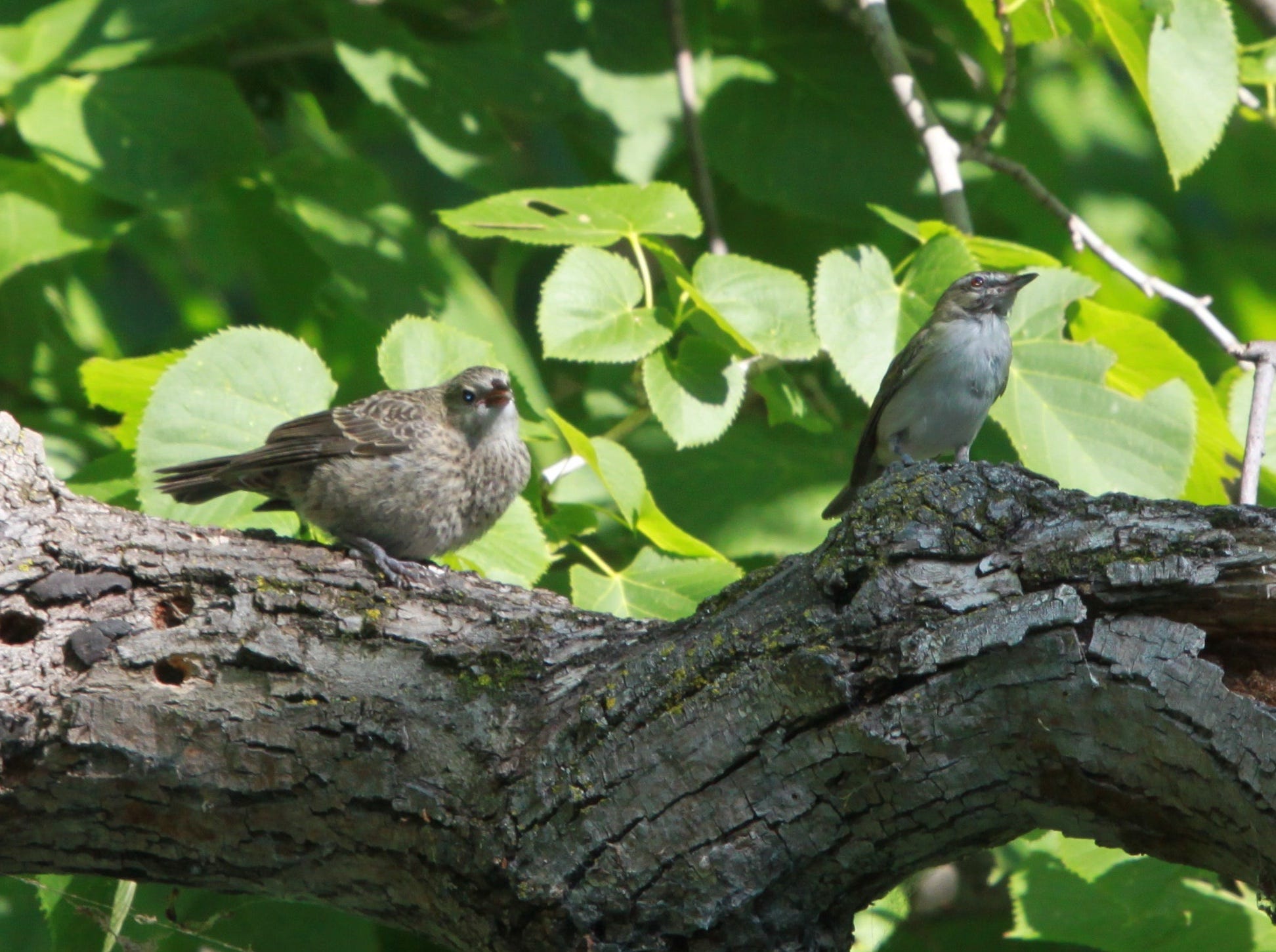
This disreputable character, parasitic in habit and degenerate in all moral instinct, gets its name through its fondness for bovine society, and its fame from its abominable habit of laying its egg in another bird’s nest.
—F. Schuyler Mathews, Field Book of Wild Birds and Their Music, 1904
Last week’s post discussed helpful birds. In contrast, Brown-headed Cowbirds and other brood parasites might be the least helpful birds. Let’s dig in.
Brown-headed Cowbirds are well-known rascals in the bird world. Nearly every other species in North America, of every avian family, lays its own eggs, incubates them, and then takes care of the young until fledging. But not the cowbird. The cowbird drops eggs into other birds’ nests—sometimes dozens of others—for the host birds to raise with their young. This causes many problems for little birds like the Grasshopper Sparrow, Kirtland’s Warbler, or Red-eyed Vireo, as the bigger cowbird babies out-compete the other nestlings.1 Like other brood parasites, baby cowbirds will push unhatched eggs right out of the nest.
She hunts stealthily in the woods, usually among the undergrowth, and when a nest is discovered, patiently awaits from a convenient hiding place the temporary absence of the parent, when the test is stealthily and hastily inspected and if found suitable she takes possession and deposits her egg, when she departs as quietly as she came.
—Robert Ridgway, Ornithology of Illinois, 1889
It gets worse, though. If a cowbird finds a nest full of the host’s chicks, it’ll toss out the nestlings so the whole process has to start over. That means more opportunities to dump some of their own eggs. And cowbirds will retaliate against the host if one of their eggs doesn’t hatch.
In response, a few birds like American Robins and Yellow Warblers have adapted to deter cowbirds. PhD student Sarah Winnicki shared in a 2020 presentation that Yellow Warblers recognize cowbird eggs and will bury them under nesting material. Robins will chuck cowbird eggs out of the nest.
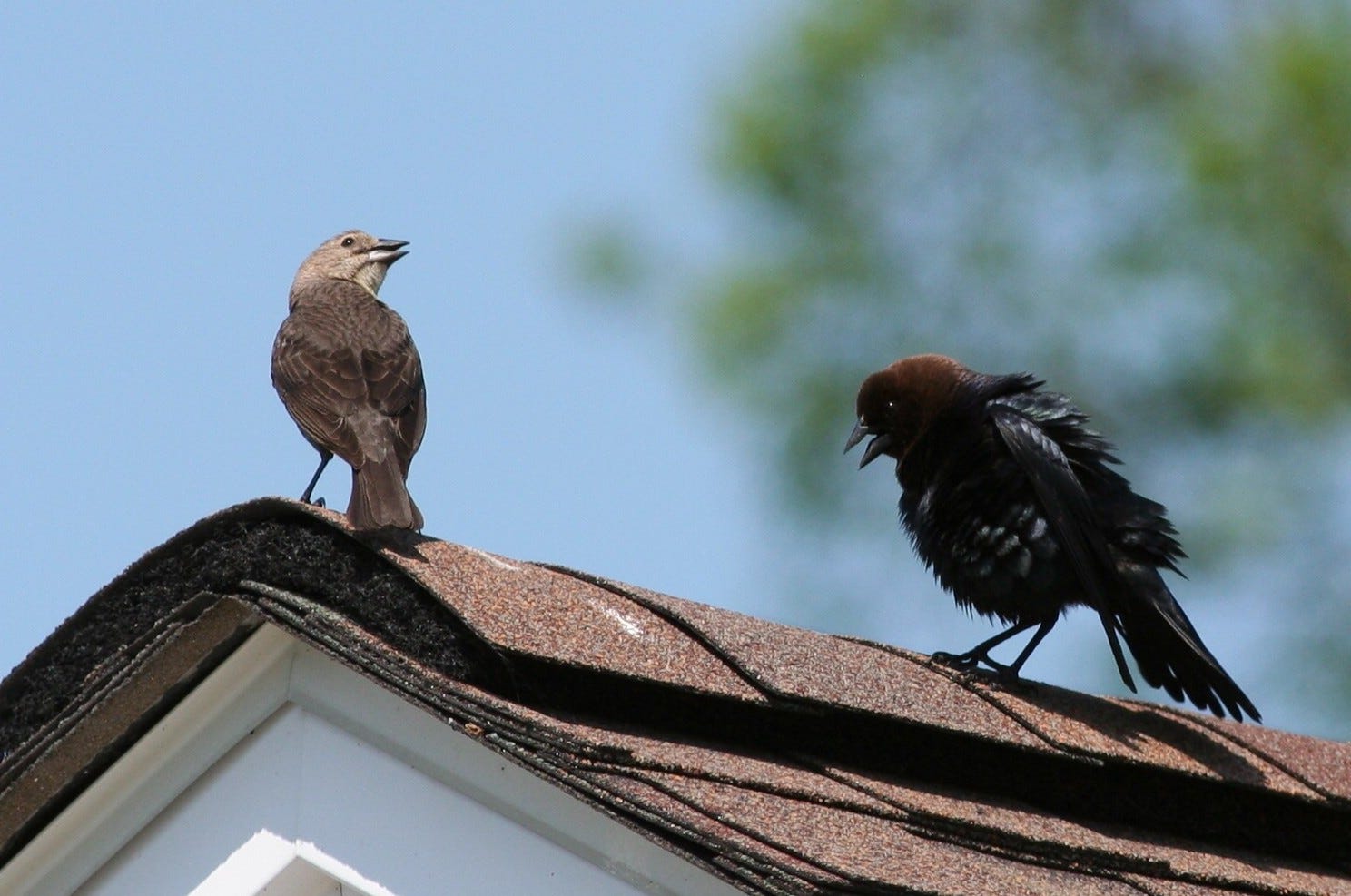
They are slim and graceful, about one-fifth smaller than the robin. The males are clad in handsome coats of black, with glistening head, neck, and breast of a brown coffee color. The females wear a dress of faded black, with a lighter throat.
—Angelia Kumlien Main, Bird Companions, 1925
But maybe cowbirds deserve some respect for their cleverness.2 They’re able to proliferate their species without all of the effort of nesting and feeding. Consider that they have had to evolve to time the laying of their eggs alongside host species. Their scheming could be discovered if they’re too early. If too late, their eggs may be ignored as the others hatch and as the nestlings grow. Female cowbirds may lay up to 50 eggs in a single season—that takes inordinate energy and is a volume that increases the odds of success.
Winnicki states that cowbirds may poke holes in eggs to get a peek and determine how far along they are. Again, another interesting adaptation, one that requires stealth and savvy. And cowbirds have to be unusually observant to even find nests and recognize when egg-laying occurs. These are indeed clever birds.
And unlike some “destructive” species, cowbirds are native birds, that first followed the bison of the Great Plains, benefiting from all the seeds and grasshoppers stirred up by the herds. They then adapted to the cattle introduced in recent centuries and their range expanded east and north.
Cowbirds are back in these climes at this time of year, and I may look at them differently this spring. Even these scamps could use our support.
Source: Sarah Winnicki, “Cowbirds: villainous mobsters or falsely maligned native species,” Wichita Audubon Society, September 15, 2020.
The good folks at the Kirtland’s Warbler Alliance have worked for decades to deter cowbirds parasitizing endangered warbler nests. If they don’t enjoy cowbirds, I’d surely understand!
Thanks for the detailed descriptions and facts.
I’ve seen cowbirds pushing other smaller birds from a neighbors feeder in NE Oregon. They are not easy to appreciate. But our human judgement of them is misguided. They have their place in their the environment that we may not understand. It’s a species that evolved with all other wildlife, not an introduced bird like the Starling. But it’s still not a bird that’s very lovable!