


For a moment, I was some clodhopper down in Griffith, Indiana. You know the line from A Christmas Story. The Old Man tells Mrs. Parker about a news story, real news.
“Did you hear about this guy who swallowed a yo-yo? ... Yeahhh, on a bet! Some clodhopper down in Griffith, Indiana.”
For a few hours in late December, that was me: a clodhopper down in Griffith, Indiana. I hadn’t swallowed a Duncan product or won a bowling alley (that was in Terre Haute). But I did participate in the Dunes West Christmas Bird Count on a waterlogged day in the final week of 2025.
The rain was a sight to behold. It came down in sheets from about sunrise through the late afternoon. Water was ponding everywhere, and The Region’s many drainage ditches and impoundments were near-overflowing. It was the second straight year the count took place in a deluge. We’re on the edge of the Lake Michigan snow belt, making downpours in the middle of winter—apparently now de rigueur—even more anachronistic.
I found myself on the fringes of the Griffith-Merrillville Airport, its runway just yards from where I located a few soggy passerines. The homes and yards here are quite spread out compared to Chicago. As I trekked toward a promising greenway, I heard chickens clucking from a backyard coop. I wouldn’t get anything but a couple sparrows at the greenway, which presaged an increasingly desperate search for most any bird to count that morning, the rest of which took place from the warm and dry confines of my late model Honda.
At one point I went two hours without seeing a single bird, such was the biblical rainfall. I circled through several cemeteries, studying every tree and shrub and even a few monuments for signs of any movement. Then I scanned a few retention ponds by Costco and Hilton Garden Inn and still came up empty.
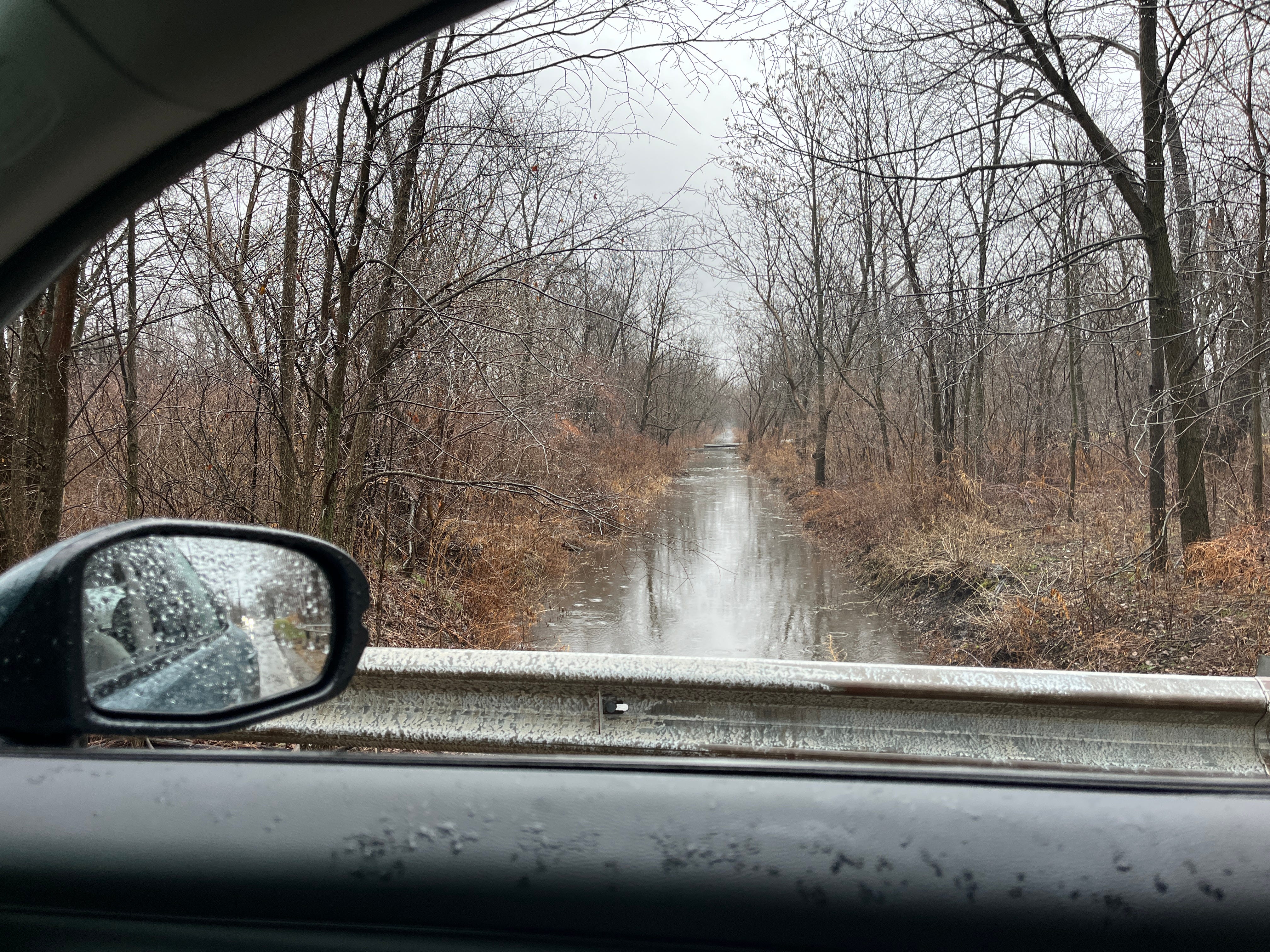
I headed back north to Ross, an unincorporated community alongside Gary. Here’s where I encountered a swampy landform, the Cady Marsh Ditch. This humble but wild tract is a remnant of the Lake Michigan strand plain. This once was the ancient lake shore itself, where water sloshed back and forth as the glaciers retreated, leaving a series of remnant shorelines on the landward side. Some of the remnant shorelines resulted in the larger dunes like the Tolleston. There are signs of this all throughout The Region and into Illinois, too. As the glaciers retreated, the earth’s crust rebounded from the weight of the ice. Lake Michigan was much larger and stretched well into Illinois and Indiana. Each time there was a rebound more water went from the southern Great Lakes toward the St. Lawrence River watershed, and the lakes reduced in size. Ancient Lake Michigan receded, leaving little gullies like Cady Marsh Ditch behind. Most of the natural shorelines have long since been eradicated by industry.
I was running out of adjectives to describe the rain when I entered Ridgelawn Cemetery near Ross. There were wooded stands on the periphery of the large graveyard that looked enticing though proved empty. I looked every cemetery tree up and down for signs of life. At the top of one scrawny conifer, there was either a bird or a clump of leaves. It turned out to be a bird, riding out the storm on a lofty perch. It was a small raptor, and when I really focused it was clearly a Merlin.
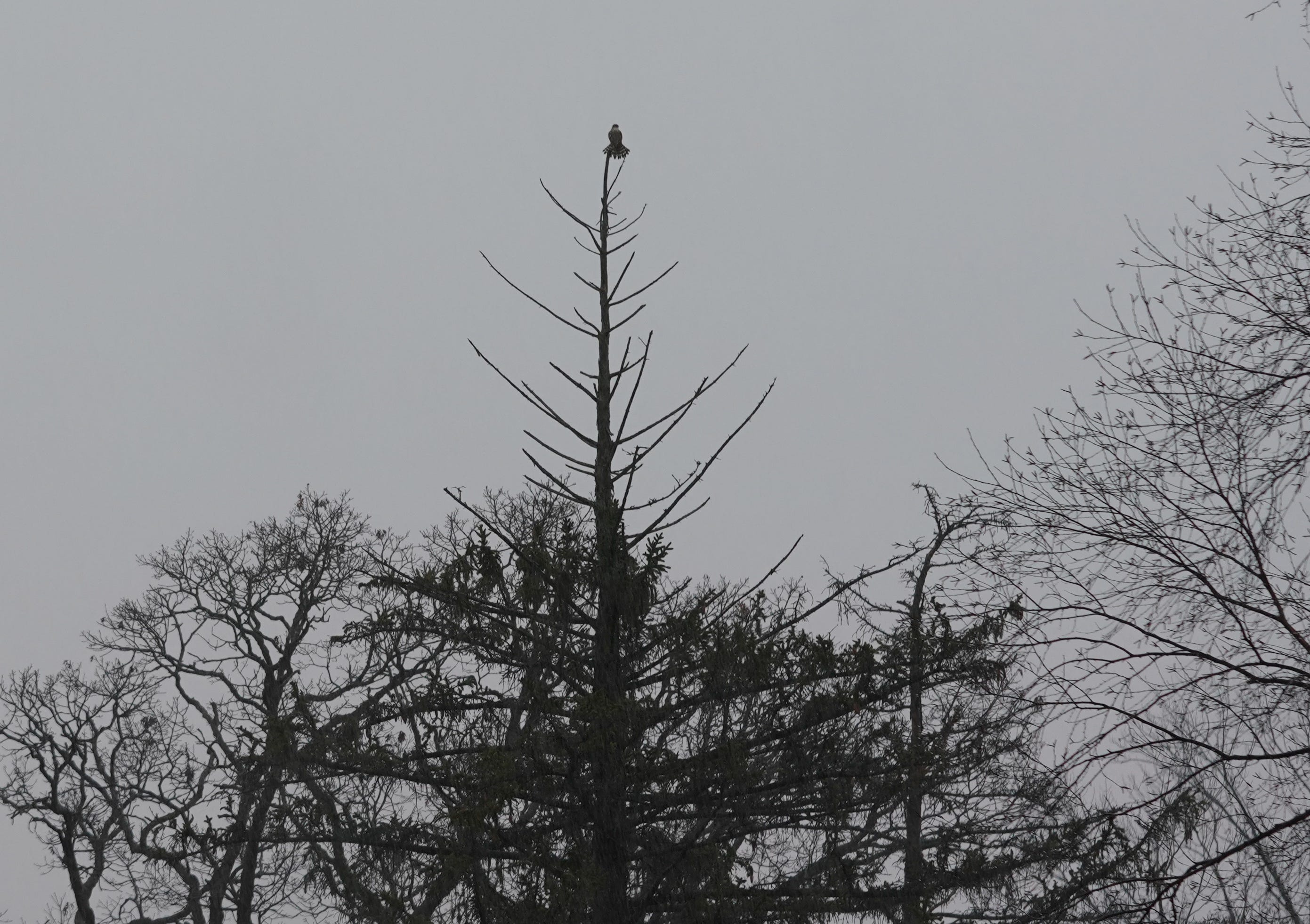
As there was nothing else to do, I watched it for a while, and it stayed in place despite the conditions. Merlins aren’t around my usual haunts, so this was exciting (in fact, a first for my Indiana life list).
I concluded the day with a list so brief that it could have been written on a napkin. But that Merlin and visiting places like Cady Marsh Ditch made it memorable.
More antics from the Bears
When last we discussed the Chicago Bears’ desire for a new stadium, this space noted that the all-glass façade placed along Lake Michigan would be devastating for birds making their way north or south during migration. The Bears’ stadium situation has long been, well, weird. Helmed by the mercurial McCaskey family, the team renovated the old Soldier Field with a widely panned design back in the early 2000s. The bizarre current situation, though, has many longing for a time when we could just make fun of the old renovation. Soldier Field was rocking this year as the Bears had their best season in recent memory. Millions and millions of dollars are still owed to the state for that 2003 renovation.
Now the forces are aligning for the Bears to play their home games in Hammond, Indiana, just across the Illinois border. Birders’ ears perked up all over Chicagoland when the news came that the site would be at Wolf Lake, a noted avian hotspot. On the Illinois side of the lake, there have been 248 species observed. Adjacent Eggers Grove has seen 254. On the Indiana side—perhaps birded less often—there have been 234 species observed, fifth most of any site in Lake County, Indiana.
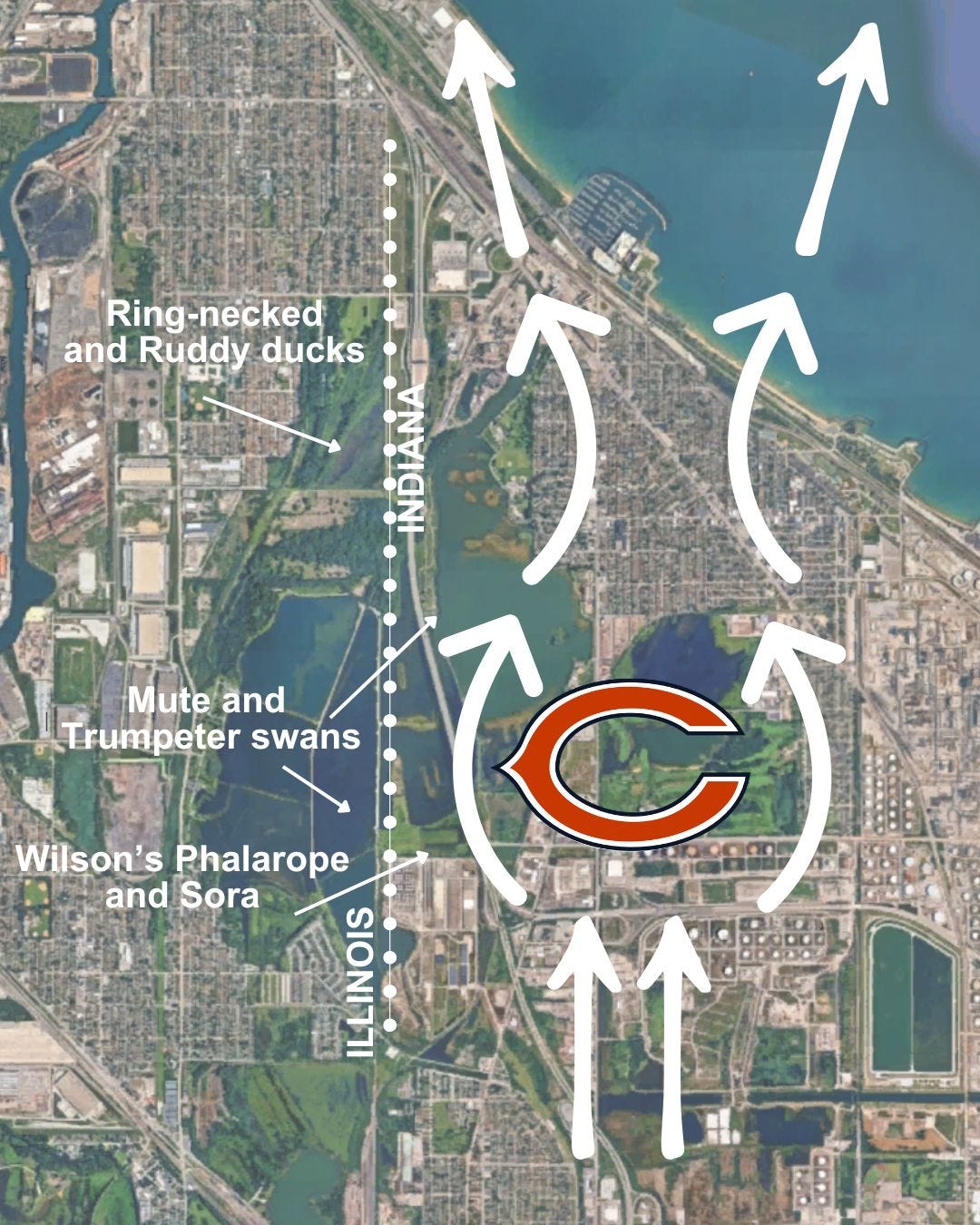
The stadium placement would affect both resident and migratory birds. Wolf Lake just isn’t any inland lake, it sits at the southern tip of Lake Michigan meaning it’s along a vital migratory corridor for much of the year. Birds coming from the south use the area as a stopover point when they encounter the vast expanse of the lake—a major obstacle and one that requires inordinate expenditures of energy. A stadium placed there be yet another obstacle in getting to the northern breeding grounds. In fall migration, the problem would be reversed. Then there are all the breeding birds like Mute Swans and Caspian Terns that would be pushed to the western side of Wolf Lake as the stadium is constructed.
Commissioner Roger Goodell is said to have visited Wolf Lake as part of a Bears-led tour of potential sites. I wonder if he brought a spotting scope to view the swans.
Looking for other ways to support? Buy me a coffee to make a one-time contribution. I appreciate your generosity.

So many obstacles, so much paved over habitat. Sigh. But great sighting of the merlin !! on a difficult birdy day.