


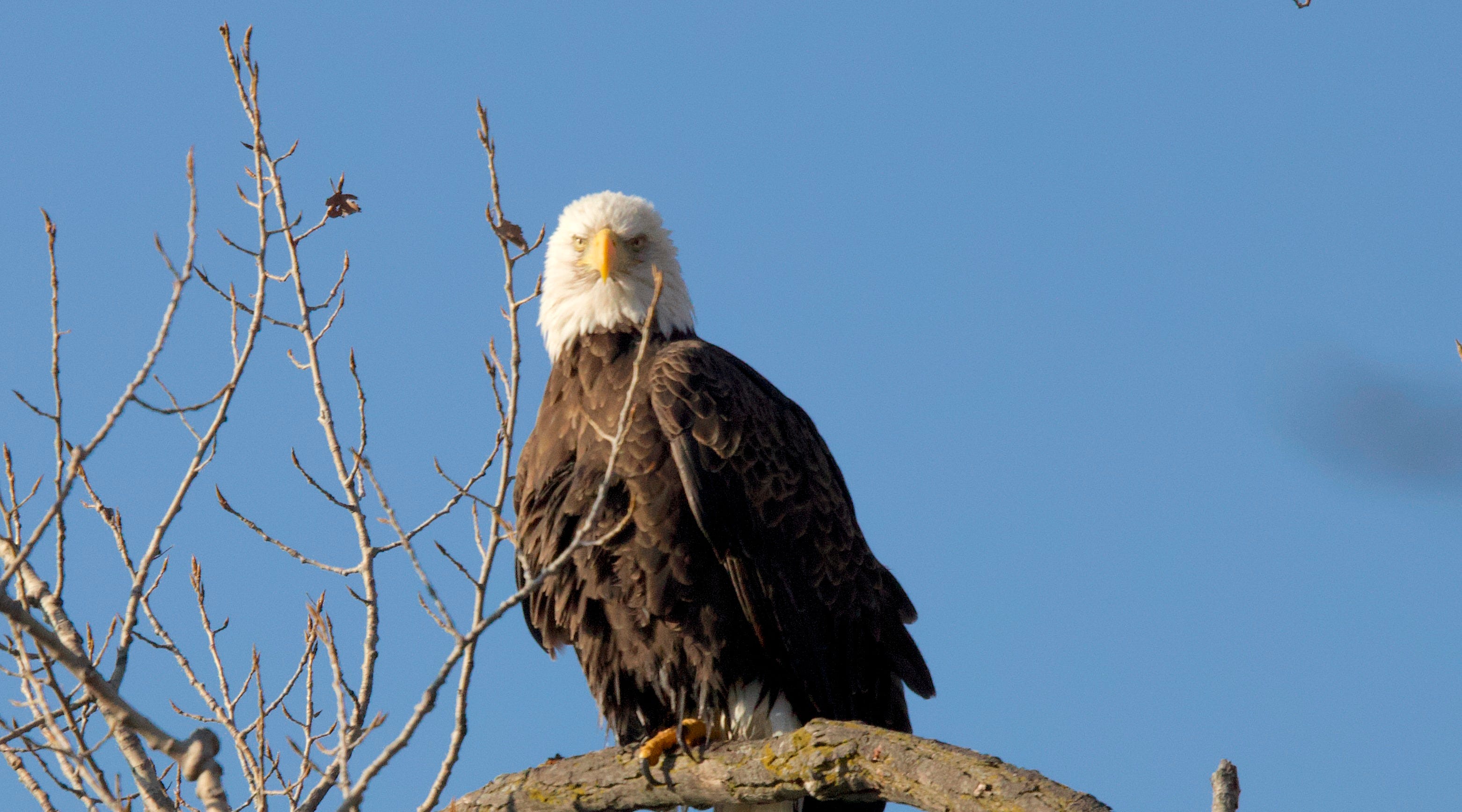
The news arrived recently of the first Bald Eagle eaglets hatched in the city limits of Chicago in more than 100 years.1 The success is a testament to the recovery of the heavily industrialized Calumet region on the city’s Far South Side. Bald Eagles are returning to waterways all across the state, perhaps in numbers not seen since the late 1800s or early 1900s The years from 1943 to 1973 went without any nests in Illinois2; but by 1991 there were six nests, scattered from the northwest corner of the state on the Mississippi River to the southeast corner on the Wabash.3
In reflecting on this recent milestone, my thoughts go from the Land of Lincoln to The Heart of It All.4 It isn’t too much of a stretch to say that the return of nesting eagles in Chicago traces all the way back to recovery efforts led by the State of Ohio starting in the 1980s. Back then, a Bald Eagle sighting in Ohio was still a real anomaly and worthy of a rare bird alert—much like Illinois, there were only four nests in the state.5 That would start changing by the mid-1990s, when the eagles became a frequent sight in the western Lake Erie basin, including a large nest visible from the Ohio Turnpike. There were 38 nesting pairs by 1997.
The Bald Eagle returned to Ohio—eventually nesting in 87 of the state’s 88 counties— because of a program of the Ohio Department of Natural Resources (the banning of the pesticide DDT helped, though illegal shooting and human disturbance also were factors). The program bears quite a bit of resemblance to the Piping Plover recovery effort in the Great Lakes, what with nest monitors, egg rescues, and captive-rearing.
Kenn Kaufman wrote about the program in 2019’s A Season on the Wind:
In the most hands-on approach, [ODNR] became adept at moving young eagles into and out of nests. If adult eagles were killed or abandoned a nest after eggs hatched, the biologists would take the young in to raise them by hand, or move them into the nest of a pair of eagles that had lost their young. If eggs failed to hatch, the biologists might be able to provide the adults at that nest with young that had hatched elsewhere.
One of the big problems was there just weren’t many trees remaining that once populated the Great Black Swamp in the northwest part of the state. There were towering cottonwoods, though. It was once thought the tall-yet-brittle trees couldn’t hold the weight of an eagle nest, though eventually the birds found a way to make the Populus trees work. An eagle perched in a cottonwood or sycamore by a river is a sort of prototypical image of the species, however the Ohio raptors often also began nesting well away from the water, too, taking advantage of tall trees as far as 5 miles away from riparian areas.
As the population grew around Lake Erie, eagles started to reclaim the northern tributaries of the Ohio River, the Wabash River, the Scioto River, and the Licking River. They made their way farther and farther west and became established as nesters on the lower Wabash, the Illinois River, and the Mississippi River, too. Then they moved up the Fox River corridor and into the Chicago Area Waterway System, a fancy name for the network of waters that includes the Chicago and Calumet rivers. Wintering eagles had long been present in numbers, but now they were staying through summer, too.6
There have been a constellation of groups working together to make the Calumet more hospitable to birds. The eagles’ nest is on a small parcel owned by the Chicago Park District, near industrial businesses with names like Cargill, Atlas Tube, Watco, Ozinga, and Ford. That we’re even discussing eaglets in this area—and there’s a naming contest under way—is something of a miracle (I wonder how Calumet River fish taste?). Stories like this one show just how wild our metropolis can still be.
Last call: I’ll be teaching a class at Chicago Botanic Garden* for four weeks starting Monday, June 8—seats are still available! Curious about the intersection of birds, art, and history? Birds in art do not begin and end with John James Audubon. Delve in and learn about the stories of various birds through historic materials, including the works of Francis Willughby, Mark Catesby, Thomas Bewick, Sarah Stone, and lesser-known figures in bird conservation such as Wisconsin’s Kumlien family. We’ll also get a chance to visit the Lenhardt Library at the Garden and explore rare materials in-person. Learn more here.
*Garden membership is not required to take the class. Parking and admission are included in the cost of the class.
Bald Eagles did build a nest in Chicago in 2004, but egg-laying and hatching were never confirmed.
H. David Bohlen, “An Annotated Check-list of the Birds of Illinois,” Springfield, Illinois: Illinois State Museum, 1978.
Vernon M. Kleen, Liane Cordle, and Robert A. Montgomery, The Illinois Breeding Bird Atlas, Champaign, Illinois: Illinois Natural History Survey, 2004.
An old tourism slogan for the state. Every elementary school kid in Ohio once learned the song, “Beautiful Ohio,” a source of a great deal of state pride.
Source: https://ohiodnr.gov/discover-and-learn/animals/birds/bald-eagle
Increasing breeding numbers in the north—think Wisconsin and Minnesota—probably also had something to do with the nests in the lower Midwest.