


We’ve covered in this space before that the Baltimore Bird, or Baltimore B*stard, wasn’t named because of a concentration of Icteridae in Maryland. Rather, our most common oriole species was named so because of an association with Lord Baltimore.
Here’s a post excerpt that mentions the artist Mark Catesby’s depiction in the 1700s:
The Baltimore Oriole was already associated with Lord Baltimore and Maryland by Catesby’s time. That’s because Lord Baltimore’s family coat of arms, still seen in Maryland’s state flag to this day, included gold and black prominently.
The male Baltimore Oriole is bright orange and black. The female is more yellowish and black. They don’t quite match the Maryland flag, but apparently that didn’t deter people like Catesby from going with the name.
The Baltimore baseball team has been called the Orioles since the St. Louis Browns moved to the Free State in 1954. For most of the franchise’s existence, the team’s logo was a cartoonish Oriole that had a duck bill and goofy eyes. It didn’t really do anything to educate people about these stunning birds.
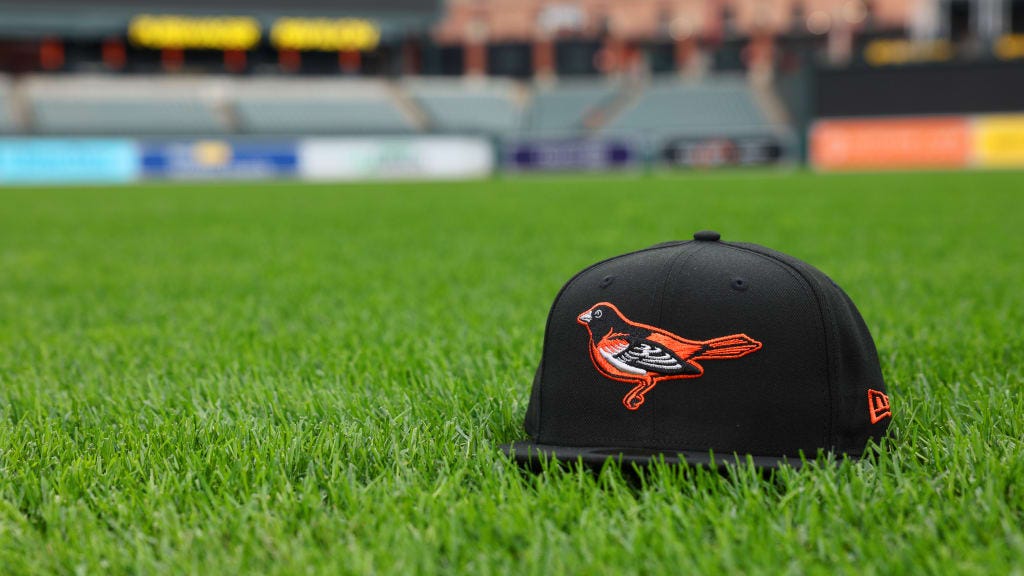
Then in 1992 the team suddenly unveiled a new logo that showed an Oriole in side profile. It was like something from a Peterson or Sibley field guide.
During the retro craze of the 2010s, the team went back to the old cartoonish logo. I admit, it was kind of fun. But it was still a lesser bird logo than the Toronto Blue Jay and the St. Louis Cardinal.1
Then came the news last week that the ornithologically correct logo was coming back, at least on a limited basis. “This hat will be for alternative use and will not be replacing any of the Orioles' other on-field caps,” a news report said.
As nice as this is, the O’s still need to do something about the Delmarva Shorebirds, their Single-A affiliate in Salisbury, Maryland. The Shorebirds have a great logo, but unfortunately it shows a heron rather than a shorebird. Herons and egrets are waders, and though sometimes found on the shore, they are not oystercatchers, plovers, or sandpipers.
For now though we’ll appreciate the return of a handsome bird depiction if or when the 2027 season gets under way.
Enjoying these posts? Not ready for a Substack subscription? Buy me a coffee through BuyMeACoffee.com. It’s a simple, low-cost, and one-time way to support my work.
If you liked this post, you also might like:
Plover Joe

In the late 1800s and early 1900s, a flood of immigrants from central and eastern Europe came to the United States to work as millhands, lumbermen, and miners. I know this firsthand because my great-grandparents and grandparents were among them. Theirs was difficult, dangerous, and menial …
This one has been problematic because the cardinal has a yellow bill instead of an orange bill. Further, there is no female shown.
I went down a baseball-teams-named-after-birds rabbit hole last week and was stunned to learn that Blues in Cleveland’s inaugural season was short for Bluebirds.
Great stuff.