


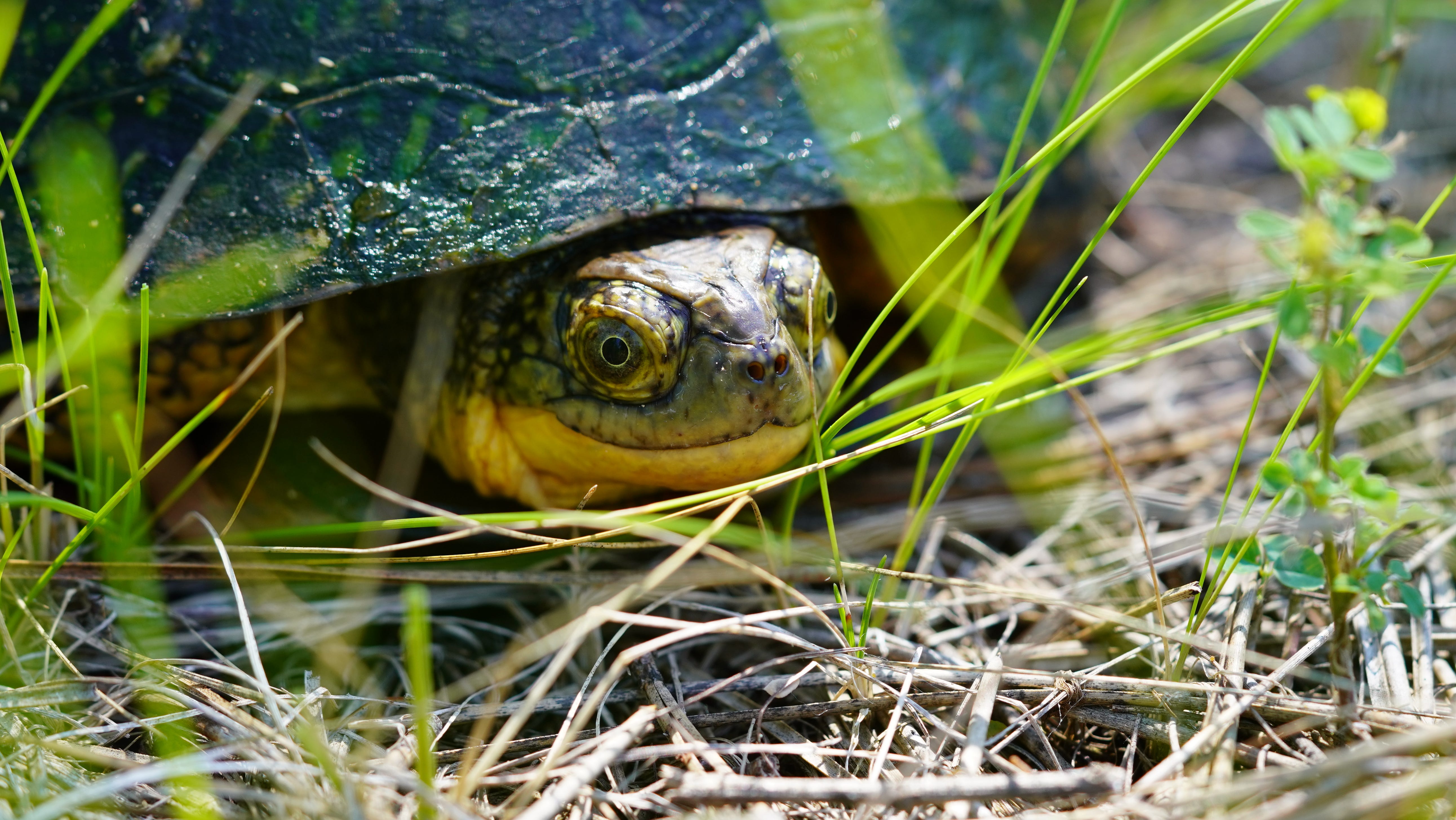
State-endangered Blanding’s Turtles are up against a lot, living in the Chicago suburbs, with their tangle of roads, housing developments, and industry. Unlike most turtles, female Blanding’s make long-distance nesting forays—up to 3 miles!—migrating to the ancient beach ridges where they hatched.
“A turtle walking three miles,” said Gary Glowacki, Manager of Conservation Ecology, Lake County Forest Preserves, “there are not a lot of places where a turtle could walk two or three miles and not get hit by a car.”
In thinking about Blanding’s1 conservation, one has to think in terms of decades rather than years. The turtles can live up to 80 years and take about 15 years to reach sexual maturity. There aren’t short-term solutions.
“I started working here 20 years ago,” Gary said. “One of the first models I worked on, it was a really bleak outlook. Within 50 years, they’d all be gone.”
Enter the Forest Preserves’ captive-rearing program. Gary and the Forest Preserves figured it would take 100 “headstarts” per year for the next 30 years to save the local population from extirpation. The idea was to hatch and raise scores of turtles in captivity to increase the viability of the population.
“We raise them to try to get them to the size so they aren’t a tasty, bite-sized treat for predators,” Gary says.
The Forest Preserve site is close to the Wisconsin border on a former estate. The previous residents had a beach volleyball court that turns out to be the perfect location—with an artificial pool—for captive turtles.
“They live in nice sandy soils, so the volleyball court was kind of ideal,” Gary says.
I’ve had Blanding’s Turtles on my mind because I’m working on a video project about Hackmatack National Wildlife Refuge. Blanding’s Turtles are one of the many endangered species at this unique mosaic of habitats on the Illinois-Wisconsin line. I’d always known of the turtles but didn’t really understand how they were any different from the sliders and snappers in the neighborhood. Blanding’s, it turns out, are only semi-aquatic, and remain only in isolated populations in the Midwest. Northeast Illinois is something of a stronghold for the species, if nothing else because of the strength of local conservation organizations.
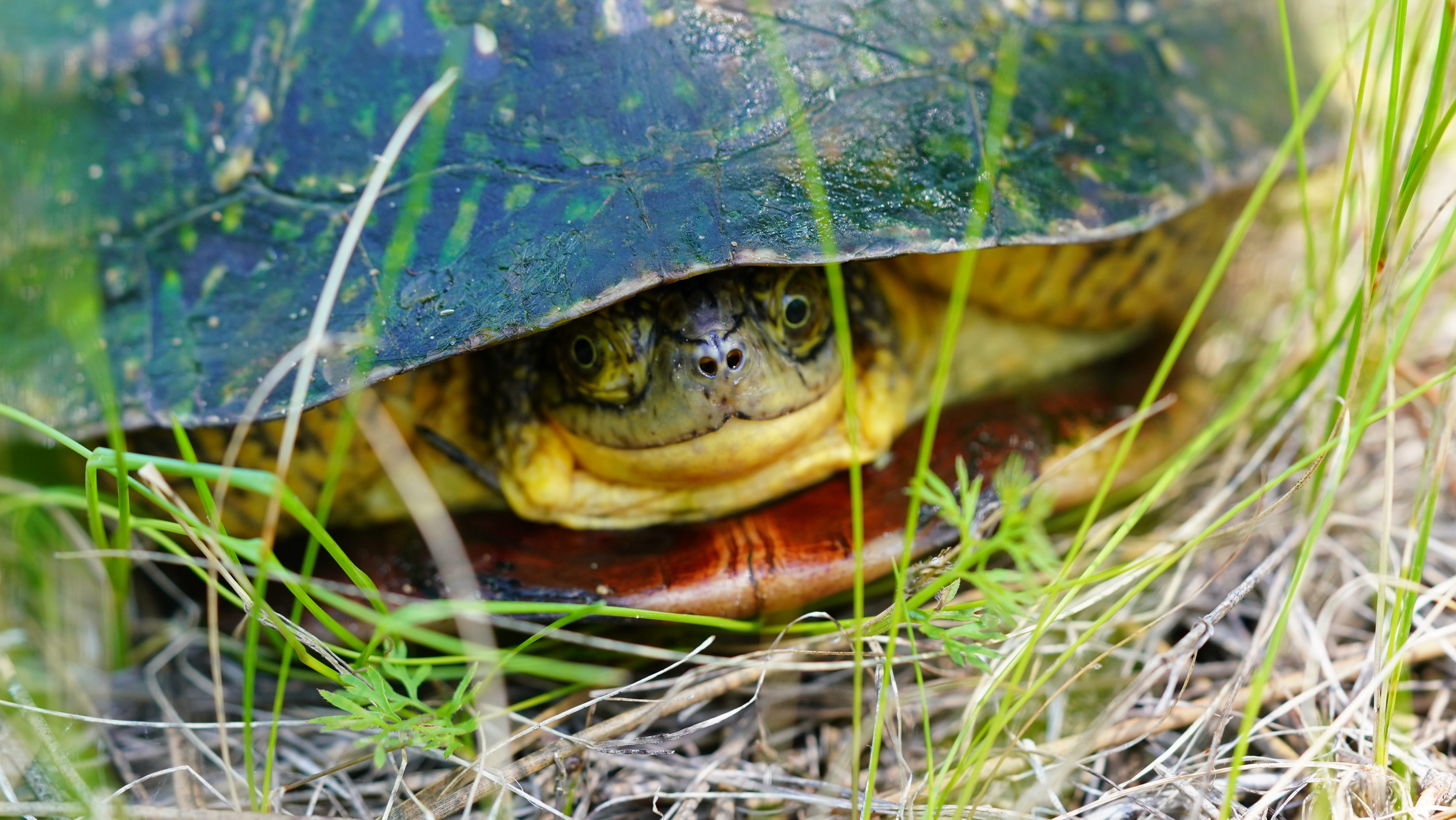
Blanding’s Turtles are one of the species that benefit most from wildlife corridors, that is, contiguous tracts of natural land where they have plenty of room to thrive. The thing is, there aren’t a whole lot of places in northeast Illinois—or really the Midwest—where they can do that. Turtles, as you might imagine, are at particular risk while crossing roadways.2 Further, they are victims of poaching and the illegal pet trade.
Blanding’s Turtle was first listed as Threatened in Illinois in 1999 due and elevated to Endangered in 2009 due to threats and declining populations. Although populations in Nebraska and Minnesota are estimated to be very large with thousands of individuals, most populations are small and isolated.
“I can’t think of another animal that’s more symbolic of the habitat we find in Lake County, the Chicago region, these coastal landscapes and…marsh habitats, prairies and savannas,” Gary told the Chicago Tribune recently. “And you quickly learn that, by protecting and conserving Blanding’s turtles, you’re really protecting a whole suite of other species.”
Enjoying these posts? Not ready for a Substack subscription? Buy me a coffee. It’s a simple, low-cost, and one-time way to support my work.

New class! The Wonderful World of Bird Behavior
Sign up for my new class at the Chicago Botanic Garden! Starting October 19, in “The Wonderful World of Bird Behavior” where we’ll be reading and discussing bird observations from favorites like Florence Merriam Bailey, Schuyler Mathews, Aretas Saunders, and Alexander Skutch. The class runs four weeks on Monday evenings, 5-6:30pm. On the fifth week, we’ll have an optional morning bird walk at the Garden.
Explore a variety of birds as they sleep, eat, sing, and dance, with an emphasis on midwestern species. Using historical texts, examine the unique behaviors of various species and come away with a better understanding of these often overlooked, but fundamental, aspects of the avian life cycle.
Blanding's Turtle is named in honor of American naturalist Dr. William Blanding (1773-1857).
Curbs are a particular problem for Blanding’s Turtles, as they have great difficulty climbing traditional curbs. The Minnesota Department of Natural Resources states that curbs with a 3:1 slope are preferred. Roads should be ditched, but not below grade which leads to greater roadkills.
If I still lived in the Chicago area, I’d love being in your class.