When I’m not watching baseball, running, or tent camping, I’m on a golf course.
Today’s round is at a corporate track in the suburbs. It’s not even noon and the smell of cigar smoke permeates a late summer day. The soundtrack is from that modern scourge, a Bluetooth speaker, blaring Hootie and the Blowfish, The Who, and Motley Crüe.
There are bits of dialog.
“Where’ve you played?”
“Kiawah. Spyglass”
“Guess where I’m going next month. Bandon Dunes.”
A weather-worn sign surrounded by invasive species says this is an Audubon Sanctuary Golf Course. The phragmites and teasel are almost blocking it out. The hedges lining the fairway are of shaped buckthorn.
Something seems amiss. A quick glance at the internet shows that this Audubon sanctioning body isn’t the Audubon you know. This isn’t National Audubon, a state Audubon, or your local chapter. This Audubon, known as Audubon International, is unaffiliated with those Audubons.
As Ralph Waldo Emerson wrote in 1849’s Nature, “To speak truly, few adult persons can see nature.” A few adult persons could discern among these Audubons. The golf course program gives the sheen of legitimacy for the golfers who notice nature at all.
A few goldenrod and boneset waved in the breeze as I teed off on the 18th hole, clinging on for dear life among the phrag. It was a good round, with fresh air, mild temps, and a few cold beverages. But the sanctuary was for the golfers. Not nature.
America’s best idea
I can recall my first camping trip to Indiana Dunes National Lakeshore. This was well before the dunes were a national park, but the same rules still applied: Leave no trace. You couldn’t so much as pick up a twig for kindling as everything in the park was (and is) protected. We were careful not to keep any rocks when we were on the beach. And we never collected any wildflowers when the spring ephemerals were in bloom.
It seems a quaint idea nowadays. First there was “border security” construction within the beautiful Big Bend National Park. Then there was a report that Major League Baseball was considering hosting a game inside the boundaries of Grand Teton National Park (is nothing sacre?). Later it was said MLB was no longer considering the idea. Commissioner Rob Manfred, already an unpopular figure, stated that MLB “had not reached the stage in our due diligence in which we evaluated the environmental impact.” Heck, it doesn’t take a study to figure out that.
Safer crossings
Wildlife crossings are becoming more and more common—and successful—in several Western states. The bridges and underpasses save animals and protect humans, too. It might be time for crossings, or at least tunnels or culverts, for species like the Blanding’s Turtle here in Illinois. Fencing can guide the turtles into the culverts, which, whether dry or inundated, can make for a safe passage.
Auguring poorly
A new ad for a web server company shows a former member of the Seattle Seahawks football team handling what’s pretty clearly an Augur Hawk, a sub-Saharan Africa species. A sharp-eyed TWiB reader brought this to my attention. As this space has noted before, the “Seahawk” is really just an Osprey. But an Augur Hawk might be easier to handle than an Osprey from a falconry perspective. It’s too bad because this could be a real educational opportunity to highlight a pretty unique local species in the Osprey.
Best bird shots
Every year that passes is the best year ever in bird photography. Cameras are better than ever, relatively affordable, and there are simply more people in the field. It’s making it such that good photos are almost commoditized. But a new list of 20 images from the Bird Photographer of the Year Award shows that composition, light, and timing still mean something.
New class! The Wonderful World of Bird Behavior
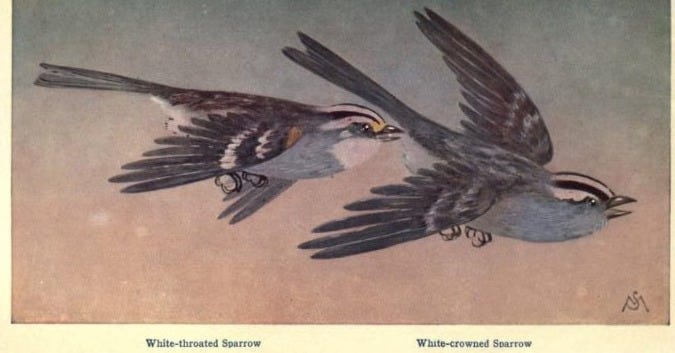
Sign up for my new class at the Chicago Botanic Garden! Starting October 19, in “The Wonderful World of Bird Behavior” where we’ll be reading and discussing bird observations from favorites like Florence Merriam Bailey, Schuyler Mathews, Aretas Saunders, and Alexander Skutch. The class runs four weeks on Monday evenings, 5-6:30pm. On the fifth week, we’ll have an optional morning bird walk at the Garden.
Explore a variety of birds as they sleep, eat, sing, and dance, with an emphasis on midwestern species. Using historical texts, examine the unique behaviors of various species and come away with a better understanding of these often overlooked, but fundamental, aspects of the avian life cycle.
Words to live by
Enjoying these posts? Not ready for a Substack subscription? Buy me a coffee through BuyMeACoffee.com. It’s a simple, low-cost, and one-time way to support my work.